
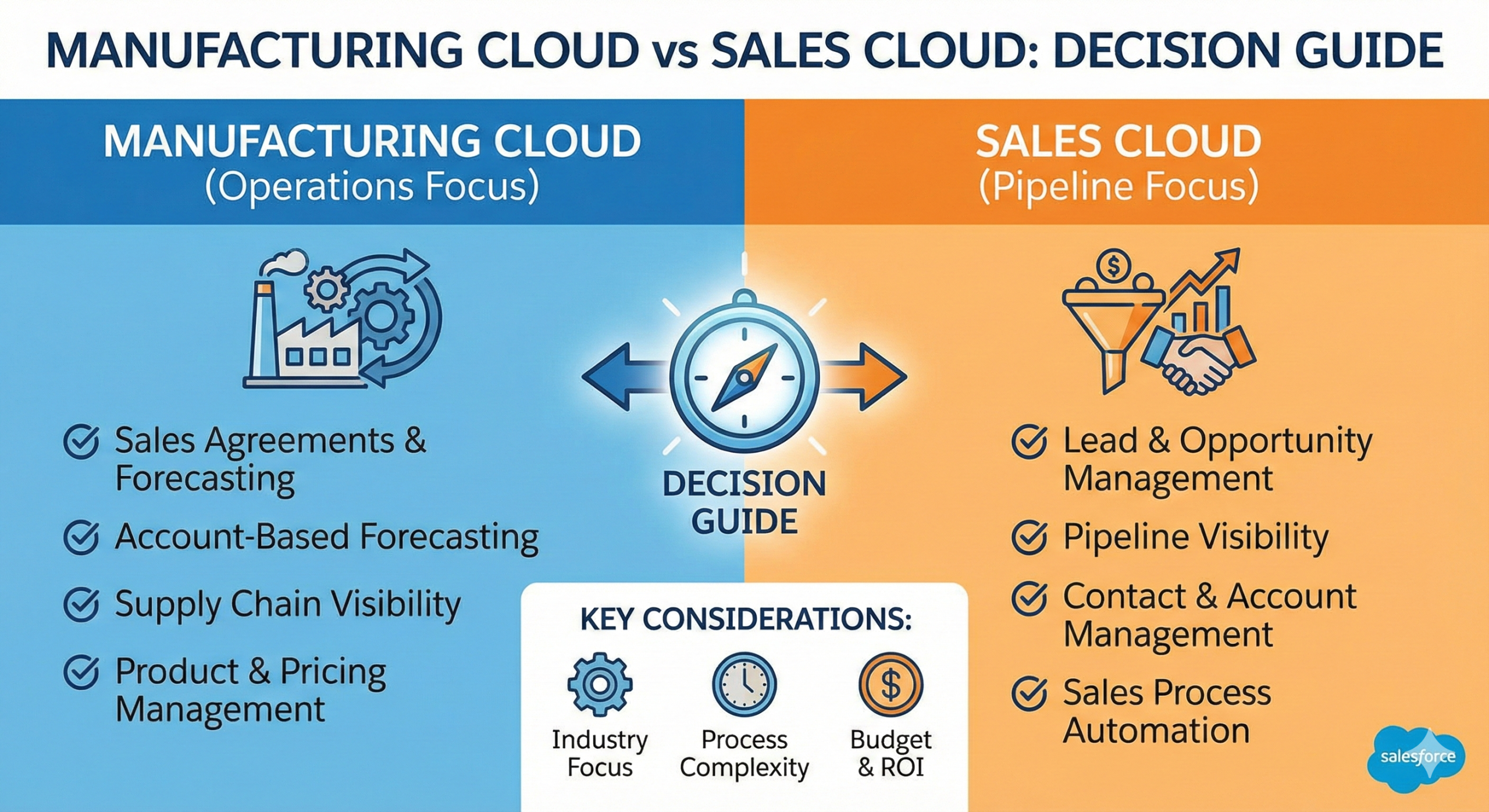
Manufacturing Cloud vs Sales Cloud: Decision Guide (When to Use Each)
Choosing between Salesforce Sales Cloud and Salesforce Manufacturing Cloud is a common decision for manufacturers modernizing their CRM. While both are built on the Salesforce platform, they solve very different problems.
Short answer:
Sales Cloud is a general-purpose sales CRM designed to manage pipeline and opportunities.
Manufacturing Cloud is built specifically for manufacturers who need account-based forecasting, sales agreements, and better alignment between sales and operations.
This guide helps you decide which one you actually need and when using both makes sense.
Quick decision summary
Choose Sales Cloud if:
Your revenue is primarily driven by individual deals and opportunities
Pipeline forecasting is sufficient for planning
You need a strong CRM foundation for sales reps
Choose Manufacturing Cloud if:
You sell based on recurring demand, run rates, or customer commitments
Forecast accuracy directly impacts production, inventory, or supply planning
Sales and operations need to agree on one forecast number
Reality check:
Most manufacturers use Sales Cloud as the foundation, then add Manufacturing Cloud to handle manufacturing-specific forecasting and agreements.
What Sales Cloud is designed for
Sales Cloud is Salesforce’s core CRM for managing the sales process from lead to close.
It’s best at:
Managing accounts, contacts, and opportunities
Tracking pipeline and deal stages
Opportunity-based forecasting
Sales activity tracking, dashboards, and reporting
Supporting quoting and pricing tools (such as Salesforce CPQ)
When Sales Cloud works well:
If your sales motion is mostly deal-driven—where each opportunity represents a discrete purchase—Sales Cloud is usually enough.
What Manufacturing Cloud adds for manufacturers
Manufacturing Cloud is a manufacturing-specific layer built on Salesforce that addresses a major gap in traditional CRM: forecasting based on accounts, not just deals.
It’s designed for manufacturers who need:
Account-based forecasting (not just opportunity rollups)
Sales agreements with planned volumes and revenue over time
Visibility into run-rate business and long-term customer demand
Forecasts that can be shared with operations and supply chain teams
When Manufacturing Cloud matters:
If customers buy repeatedly and you plan production based on expected demand over time, Manufacturing Cloud provides a more realistic forecast than pipeline alone.
The decision logic (use this internally)
1. Is your revenue deal-based or demand-based?
Deal-based sales → Sales Cloud
Recurring demand, volume commitments, or run-rate business → Manufacturing Cloud
2. What does “the forecast” need to include?
Only opportunities → Sales Cloud
Opportunities + historical orders + agreements + expected demand → Manufacturing Cloud
3. How painful is forecast misalignment?
Minor disagreements → Sales Cloud with better reporting
Frequent conflicts that impact production or inventory → Manufacturing Cloud
4. How complex is your sales channel?
Mostly direct sales → Sales Cloud
Distributors, resellers, tiered accounts → Manufacturing Cloud
Manufacturing Cloud vs Sales Cloud: practical comparison
| Business need | Sales Cloud | Manufacturing Cloud |
|---|---|---|
| CRM foundation (accounts, contacts, opps) | Yes | Yes |
| Opportunity-based forecasting | Strong | Included |
| Account-based forecasting | Custom work | Built-in |
| Sales agreements & commitments | Custom objects | Core feature |
| Run-rate & volume planning | Limited | Designed for it |
| Sales + operations alignment | Difficult | Primary use case |
Common real-world scenarios
Sales Cloud is enough when:
You’re early in your Salesforce journey
Leadership relies on pipeline to make decisions
You don’t manage long-term customer commitments
Manufacturing Cloud is a better fit when:
Forecast accuracy impacts manufacturing capacity or inventory
Customers commit to volumes over months or quarters
Sales and operations need a shared demand plan
Most manufacturers choose both when:
They want standard CRM functionality and
They need manufacturing-grade forecasting and agreements
Implementation guidance (avoid common mistakes)
Define the forecast first
Decide what must be included in the number leadership uses to plan.Start small
Roll out account-based forecasting for one region, channel, or set of key accounts.Design for decisions, not reports
If production planning depends on account commitments, Manufacturing Cloud should drive the forecast.
Frequently asked questions
Can we customize Sales Cloud instead?
Yes, but once you need account-based forecasting and time-phased commitments, customizations often become complex and fragile. Manufacturing Cloud exists to reduce that effort.
Is Manufacturing Cloud only for large manufacturers?
No. The deciding factor isn’t company size—it’s forecast complexity and the cost of being wrong.
Does Manufacturing Cloud replace CPQ?
No. CPQ handles pricing and quoting. Manufacturing Cloud focuses on forecasting, agreements, and demand planning. They often work together.
Choose the platform that matches how you actually sell
If your business runs on pipeline alone, Sales Cloud is a strong foundation.
If your business runs on customer demand, commitments, and long-term planning, Manufacturing Cloud is purpose-built for that reality.
For many manufacturers, the winning approach is Sales Cloud + Manufacturing Cloud, configured around how revenue is truly generated, not how CRM tools traditionally model it.