
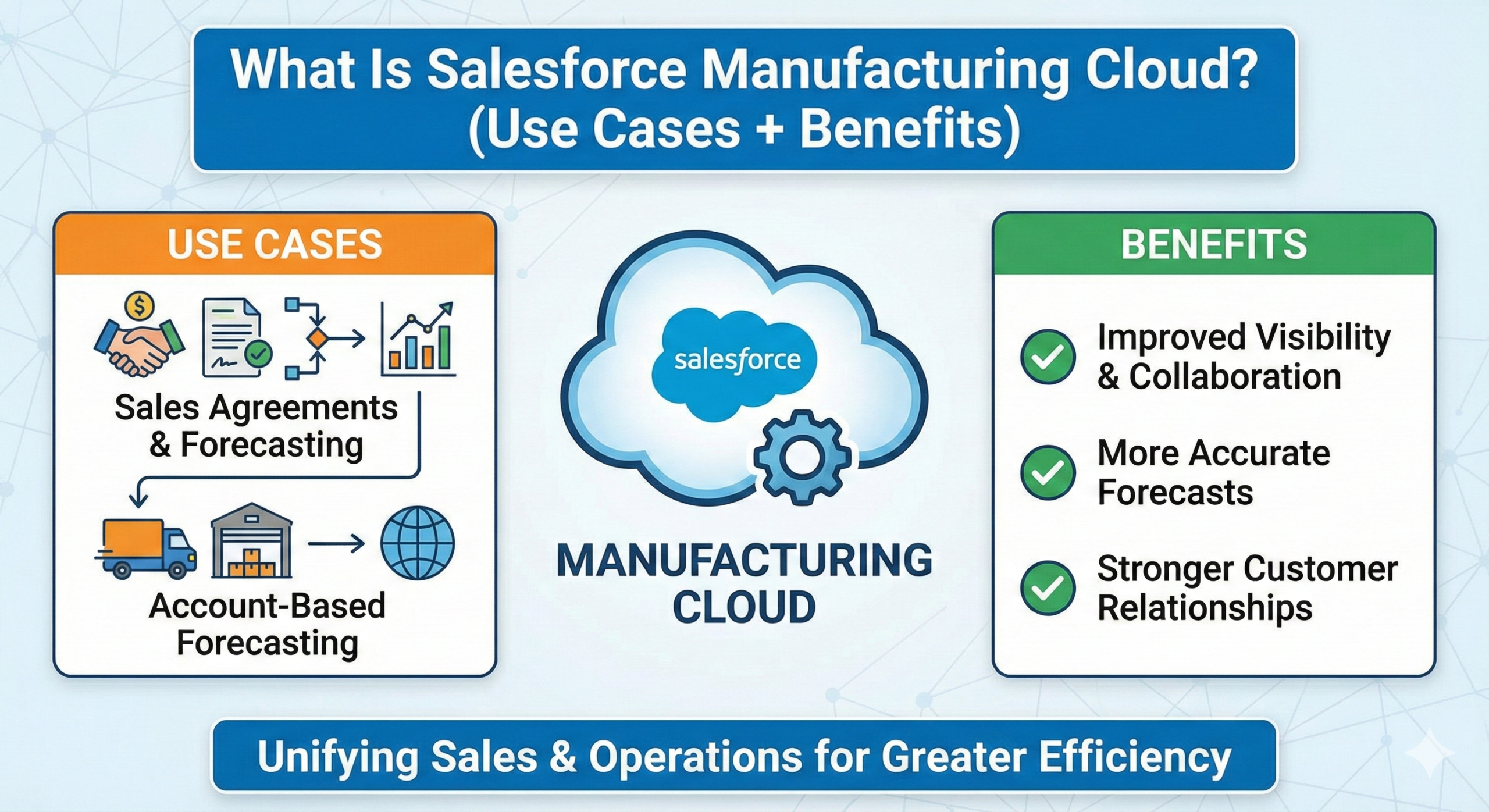
What Is Salesforce Manufacturing Cloud? (Use Cases + Benefits)
Salesforce Manufacturing Cloud (now branded as Agentforce Manufacturing) is Salesforce’s industry solution for manufacturers to manage sales agreements and create more accurate account-based forecasts by combining opportunities, orders, historical performance, and committed volumes into a single view.
It’s most valuable for B2B manufacturers selling through direct sales and/or channel partners where revenue is driven by run-rate business, customer commitments over time, and coordination between Sales and Operations (S&OP). Manufacturing Cloud helps teams track what was committed, what actually shipped/ordered, what’s likely next, and where gaps or risks are forming.
If your forecast is based only on opportunities → then run-rate and agreement-driven business gets missed or debated.
If you track commitments in spreadsheets → then visibility breaks and renewals become reactive.
If you unify committed volumes + actuals + pipeline in one place → then Sales and Ops can align on “what’s real” and plan supply, production, and revenue with less chaos.
A “good” Manufacturing Cloud program includes:
Sales Agreements for time-phased commitments and performance vs actuals
Account Forecasting / Advanced Account Forecasting for demand views beyond pipeline
A clear “system of record” plan for products, pricing, and orders (often ERP-integrated)
Governed KPI definitions (so Sales/Ops don’t argue about numbers)
What Manufacturing Cloud Is (in plain English)
Manufacturing Cloud helps manufacturers manage revenue that behaves like this:
Customers commit to quantities, products, and time periods
Actual orders and shipments vary week to week
Sales and Ops need one view of committed vs actual vs forecast
Salesforce positions it as a manufacturing-focused CRM layer that connects commercial relationships and forecasting to execution across the value chain.
What Problems Manufacturing Cloud Solves
1) “We don’t have a single view of customer commitments”
What changes
Sales Agreements track negotiated, time-based commitments and performance over time.
2) “Our forecast is a fight between Sales and Ops”
What changes
Advanced Account Forecasting can generate forecasts using inputs like opportunities, orders, sales agreements, and historical orders (plus custom sources).
3) “Run-rate business gets lost in opportunity-based forecasting”
What changes
Manufacturing Cloud is built to model long-term, volume-based commercial relationships, not only discrete deals.
4) “Renewals and agreement performance are reactive”
What changes
Agreements provide visibility into committed vs actual volumes and make renewals more structured.
Core Capabilities to Know
Sales Agreements
Used to manage long-term purchasing negotiations and track agreement terms over time.
What teams use them for
Planned vs actual volumes by product/time period
Agreement performance reviews and renewal readiness
A shared Sales/Ops view of commitments
Account Forecasting and Advanced Account Forecasting
Supports demand forecasting based on multiple inputs (not just pipeline), including orders and agreements.
What teams use it for
Account-level demand outlooks
Forecast comparisons (commitment vs actual vs pipeline)
Better planning conversations with Ops and Finance
Who Typically Uses It
Account Executives / Key Account Managers: manage agreements and customer plans
Sales Ops / RevOps: standardize forecasting logic and reporting
S&OP / Demand Planning: align commercial signals to planning inputs
Channel teams: visibility into distributor/customer commitments (where applicable)
When Manufacturing Cloud Is a Good Fit
Choose Manufacturing Cloud when:
Your revenue includes meaningful run-rate or time-phased commitments
You need a shared system for committed vs actual tracking
Forecasting requires more than “sum of opportunities”
You want Salesforce-native visibility that can integrate with ERP/order systems
Consider staying with standard Sales Cloud reporting when:
Your business is mostly one-off projects/deals with clean opportunity forecasting
You don’t need agreement objects or account-level forecasting logic
Common Pitfalls (And How to Avoid Them)
Pitfall: Treating Sales Agreements like a spreadsheet replacement without process
Fix: Define who owns agreement updates, what “actuals” source is trusted, and how often reviews happen.
Pitfall: Forecast logic isn’t governed
Fix: Create metric definitions and a single computation path for forecast KPIs (Sales + Ops use the same dashboards).
Pitfall: Data readiness is ignored (products, pricing, order history)
Fix: Start with a “golden set” of customers/products and validate the end-to-end flow before scaling.
Frequently Asked Questions
Is Manufacturing Cloud the same as Agentforce Manufacturing?
Salesforce describes Agentforce Manufacturing as the industry innovations “formerly known as Manufacturing Cloud.”
What’s the difference between Sales Agreements and Opportunities?
Opportunities are great for discrete deals. Sales Agreements are designed for tracking run-rate and time-phased commitments across products and periods.
What does Advanced Account Forecasting use?
Salesforce documentation describes generating forecasts based on sources like opportunities, orders, sales agreements, historical orders, and custom inputs.
Do we need ERP integration?
Often, yes. Especially if “actuals” are order/shipment-driven. The key is defining the system of record for orders, pricing, and inventory, then integrating the minimum needed for forecasting and agreement performance.
Book a Manufacturing Cloud Working Session
If you want a clear plan for Sales Agreements, account forecasting, and the data/integration work needed to make forecasts trustworthy, book time with our team. We’ll map your run-rate model, define the first KPI set Sales and Ops will agree on, and outline an MVP rollout that gets value fast without building a reporting mess.
Book time with our team and we’ll help you turn customer commitments into predictable forecasts.