
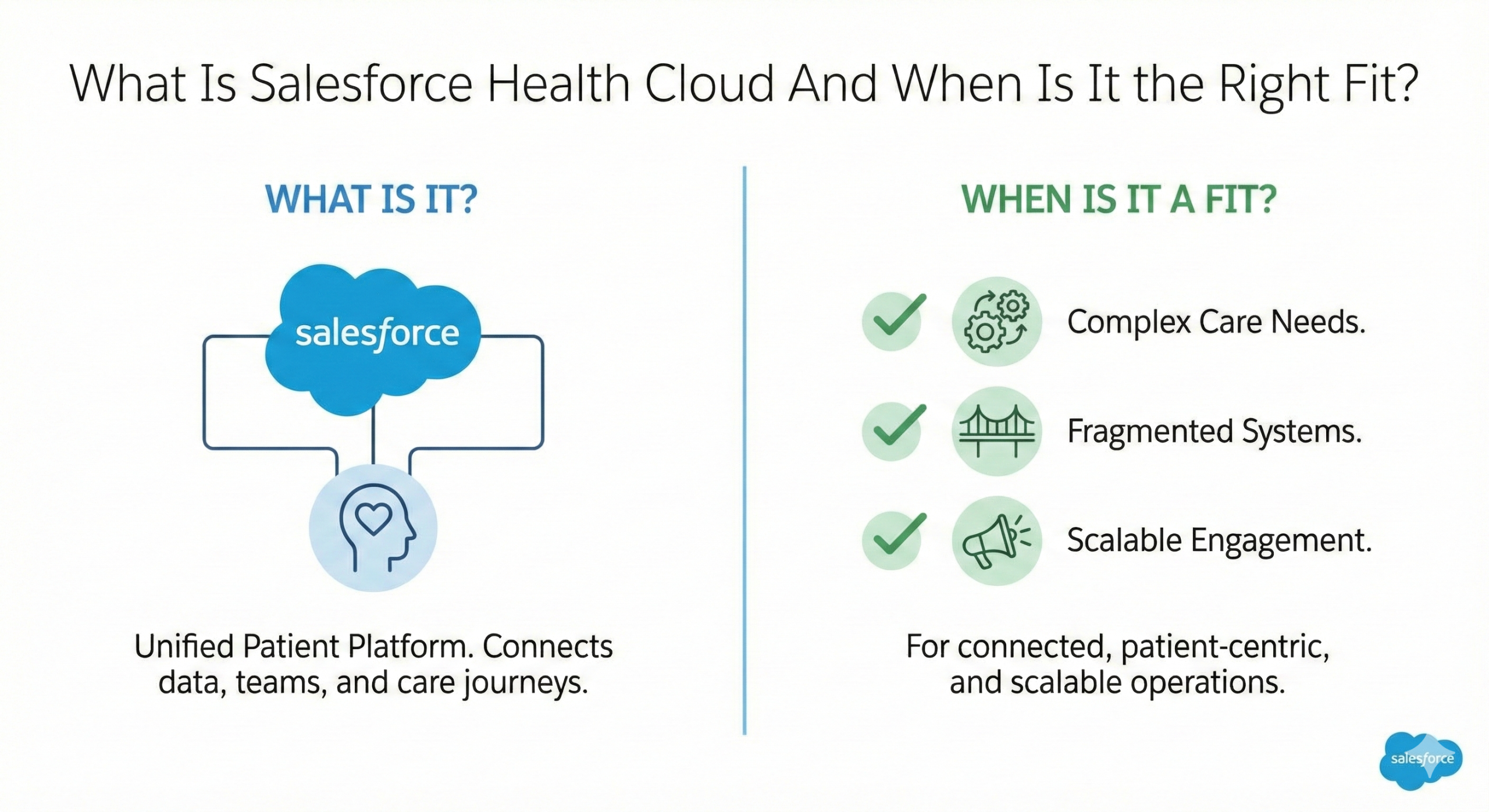
What Is Salesforce Health Cloud And When Is It the Right Fit?
Healthcare organizations don’t adopt new platforms because they want more software. They adopt them because something isn’t working: care coordination breaks down, patient engagement is inconsistent, data lives in too many systems and reporting is manual and reactive. That’s where Salesforce Health Cloud enters the conversation.
But Health Cloud is not automatically the right solution for every organization.
This guide explains what it is, and more importantly, when it’s actually the right fit.
What Is Salesforce Health Cloud?
Salesforce Health Cloud is a healthcare-specific CRM platform built on Salesforce that helps organizations manage patient relationships, care coordination, and engagement across systems. It is not an EHR or a billing system, it is a coordination and engagement layer.
Health Cloud centralizes non-clinical workflows such as:
Care plans
Referrals
Case management
Patient outreach
Member services
Household relationships
It connects to clinical systems but does not replace them. If your EHR manages medical records → keep it.
If your teams need cross-functional coordination and engagement tools → Health Cloud may be appropriate.
Ideal Organization Profiles
Health Cloud tends to work best for organizations with operational complexity.
Multi-Location Healthcare Providers
Hospital systems
Specialty networks
Value-based care organizations
Home health groups
These organizations often struggle with:
Fragmented care coordination
Referral leakage
Care gap management
Inconsistent patient engagement
If multiple departments touch the same patient → Health Cloud improves shared visibility.
Health Insurance Payers
Member services teams
Utilization management
Care management programs
If member data, case tracking, and engagement workflows are scattered → Health Cloud centralizes them.
Life Sciences & Patient Support Programs
Pharmaceutical and medical device companies managing:
Enrollment programs
Reimbursement support
Therapy adherence initiatives
If patient services teams rely on spreadsheets → scalability becomes a problem. Health Cloud adds structure and reporting.
Digital Health Startups Scaling Operations
Startups that:
Already use Salesforce
Need HIPAA-aligned engagement
Are preparing for growth
If growth is outpacing operational structure → Health Cloud can create standardized workflows early.
Maturity-Level Decision Tree
Health Cloud is not just a product decision, it’s a maturity decision.
Use this simplified evaluation model:
Stage 1: Foundational
Small team
Limited integrations
Simple workflows
Minimal reporting needs
Likely better fit: Sales Cloud or Service Cloud with light customization.
Stage 2: Expanding
Multiple departments involved in patient/member experience
Growing integration needs
Early care coordination initiatives
Increased reporting expectations
Health Cloud may be appropriate if workflows are clearly defined.
Stage 3: Complex & Distributed
Multi-site operations
Value-based care contracts
Care management teams
High regulatory requirements
Executive reporting expectations
Health Cloud is often a strong fit.
If operational complexity is low → Health Cloud may be excessive.
If coordination complexity is high → Health Cloud adds measurable value.
When Sales Cloud or Service Cloud May Be Enough
Many organizations jump straight to Health Cloud without evaluating simpler options.
You may only need:
Standard case management
Basic CRM tracking
Simple communication workflows
Limited healthcare-specific modeling
In these scenarios, standard Salesforce clouds can work well with customization.
Use Sales or Service Cloud when:
You don’t require complex care plans
Household relationship mapping isn’t critical
Healthcare-specific objects aren’t necessary
Budget constraints require phased rollout
If requirements are limited → simpler architecture reduces long-term cost.
When Health Cloud Is Overkill
Health Cloud becomes excessive when:
You are a small single-location practice
You lack defined care workflows
You have minimal integration requirements
You do not have internal governance ownership
Executive sponsorship is unclear
If process is undefined → adding complex software increases confusion.
Rule of thumb: Software does not fix operational misalignment, it amplifies whatever structure already exists.
If workflows are inconsistent → standardize first.
If data governance is unclear → define it before implementation.
Signs Health Cloud Is the Right Fit
You may be ready for Health Cloud if:
Care teams operate in silos
Referral management lacks visibility
Patient engagement metrics are inconsistent
Reporting requires manual consolidation
Leadership needs cross-functional dashboards
You are scaling beyond current operational systems
When coordination becomes strategic, not optional, Health Cloud often becomes necessary.
Final Evaluation Framework
Before moving forward, ask:
Are our workflows standardized?
Do we require healthcare-specific data modeling?
Are we integrating multiple systems?
Is cross-team visibility a priority?
Do we have executive sponsorship?
If the answer to most of these is yes → Health Cloud may be the right strategic investment.
If not → consider phased adoption or lighter Salesforce architecture first.
Final Thoughts
Salesforce Health Cloud is powerful , but it’s designed for complexity.
It works best when organizations are ready to formalize care coordination, unify engagement, and scale with structure.
It is not the starting point for every healthcare organization, it is the next step for organizations that have outgrown fragmented workflows.
If you’re evaluating it, the key question isn’t “What does it do?”, it’s: “Are we operationally ready for what it enables?”