
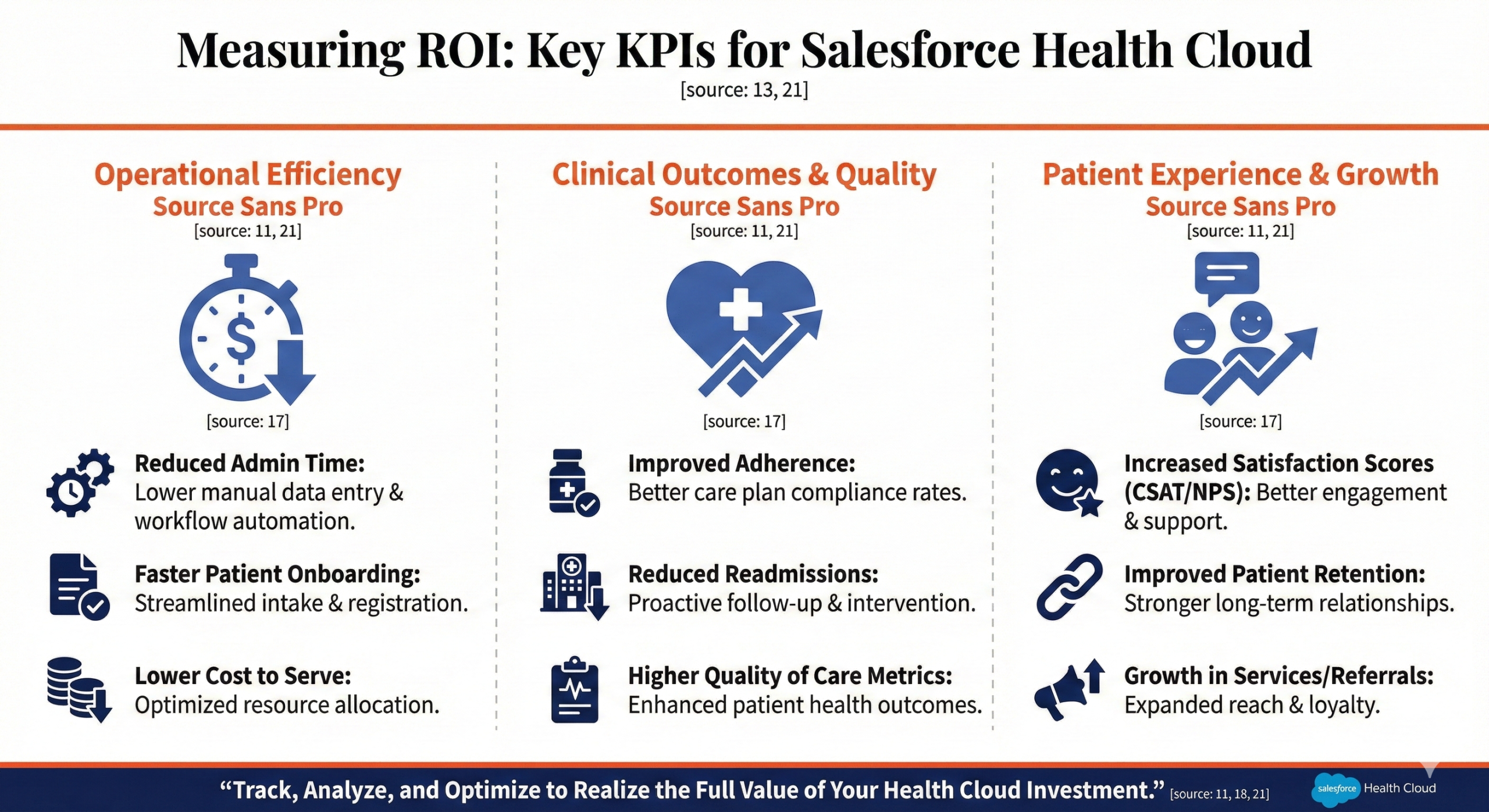
Measuring ROI: Key KPIs for Salesforce Health Cloud
Healthcare leaders don’t invest in platforms for dashboards, they invest for measurable impact. If you’ve implemented Salesforce Health Cloud, the most important question isn’t “Is it live?”, it’s: Is it improving access, outcomes, utilization, and operational efficiency?
Health Cloud enables workflow coordination and engagement, but ROI only becomes visible when performance metrics are clearly defined.
This guide outlines the key KPI categories healthcare executives should track to measure return on investment.
First Principle: Measure Operational Change, Not Activity
ROI should reflect performance improvement, not system usage. Logging more tasks or sending more messages does not equal value. The metrics must tie back to patient access, clinical outcomes, operational efficiency, or financial performance.
If KPIs measure activity → teams optimize for volume.
If KPIs measure outcomes → teams optimize for impact.
Access Metrics
Access metrics evaluate whether Health Cloud improves how quickly and efficiently patients receive care.
Core Access KPIs
Appointment wait time
Referral turnaround time
Referral completion rate
No-show rate
Time to care plan activation
When referral workflows are automated → referral turnaround should decrease.
When reminder patterns are structured → no-show rates should decline.
Why It Matters
Improved access drives:
Higher patient satisfaction
Increased revenue capture
Better preventive care compliance
If access metrics do not improve post-implementation → workflow alignment should be revisited.
Outcomes Tracking
Health Cloud supports coordination, but coordination should impact outcomes.
Common Outcome Indicators
Care gap closure rate
Chronic condition adherence rates
Post-discharge follow-up completion
Preventive screening compliance
Readmission reduction (when integrated with clinical data)
Logic:
If care plans are visible and tracked → adherence should increase.
If follow-ups are automated → care gaps should close faster.
Outcome tracking often requires integration with EHR or claims data. Without integration, outcome visibility may be limited.
Utilization Management
For payers and value-based care organizations, utilization metrics are critical.
Utilization KPIs
Emergency department utilization rate
Avoidable admission rate
Care management enrollment rate
High-risk patient identification accuracy
Case resolution time
When coordination improves → avoidable utilization should decline.
Health Cloud’s value in utilization management depends on:
Accurate risk segmentation
Integrated claims data
Structured care management workflows
If identification exists without workflow intervention → utilization will not change.
Engagement Performance
Engagement metrics validate whether patient communication strategies are effective.
Engagement KPIs
Appointment confirmation rate
SMS/email response rate
Care gap campaign response rate
Portal activation rate
Adherence campaign engagement
If engagement increases but outcomes do not improve → workflow design may be misaligned.
Engagement performance should always connect to operational metrics, not stand alone.
Cost-to-Serve & Operational Efficiency
Health Cloud often reduces manual work across departments.
Efficiency KPIs
Case handling time
Manual data entry reduction
Duplicate record reduction
Staff time spent on coordination
Automation-triggered task completion rate
If automation increases but staffing burden does not decrease → workflow configuration should be reassessed.
Cost-to-serve improvements often appear as:
Reduced administrative overhead
Faster case resolution
Fewer escalations
Cleaner reporting cycles
These metrics resonate strongly with executive leadership.
Connecting KPIs to Executive Strategy
Health Cloud performance metrics should align with strategic priorities.
For example:
| Strategic Goal | Supporting KPI |
|---|---|
| Improve preventive care | Care gap closure rate |
| Increase revenue capture | Referral completion rate |
| Reduce avoidable admissions | High-risk outreach completion |
| Improve patient satisfaction | Wait time reduction |
| Improve operational efficiency | Case resolution time |
If KPIs are disconnected from strategic goals → ROI narratives weaken.
Building a Health Cloud ROI Dashboard
An effective executive dashboard should include:
Access metrics (monthly trend)
Outcome indicators
Utilization patterns
Engagement performance
Operational efficiency
Reports should show:
Baseline (pre-implementation)
Current performance
Percentage improvement
Variance by department
If baseline data is not captured before implementation → ROI measurement becomes speculative.
Always establish a pre-go-live benchmark.
Common Measurement Mistakes
Organizations often:
Track too many metrics
Focus on engagement volume
Ignore baseline comparison
Fail to assign KPI ownership
Disconnect reporting from workflow adjustments
Measurement must drive iteration.
If KPIs stagnate → workflows should evolve.
Final Thoughts
Salesforce Health Cloud delivers ROI when it changes how care is coordinated, not just how data is stored.
The most valuable KPIs measure:
Faster access
Better adherence
Reduced unnecessary utilization
Higher engagement quality
Lower administrative burden
When performance measurement is built into architecture and workflow design, ROI becomes visible and defensible.
If Health Cloud is live but outcomes are unclear, the issue is rarely the platform.