
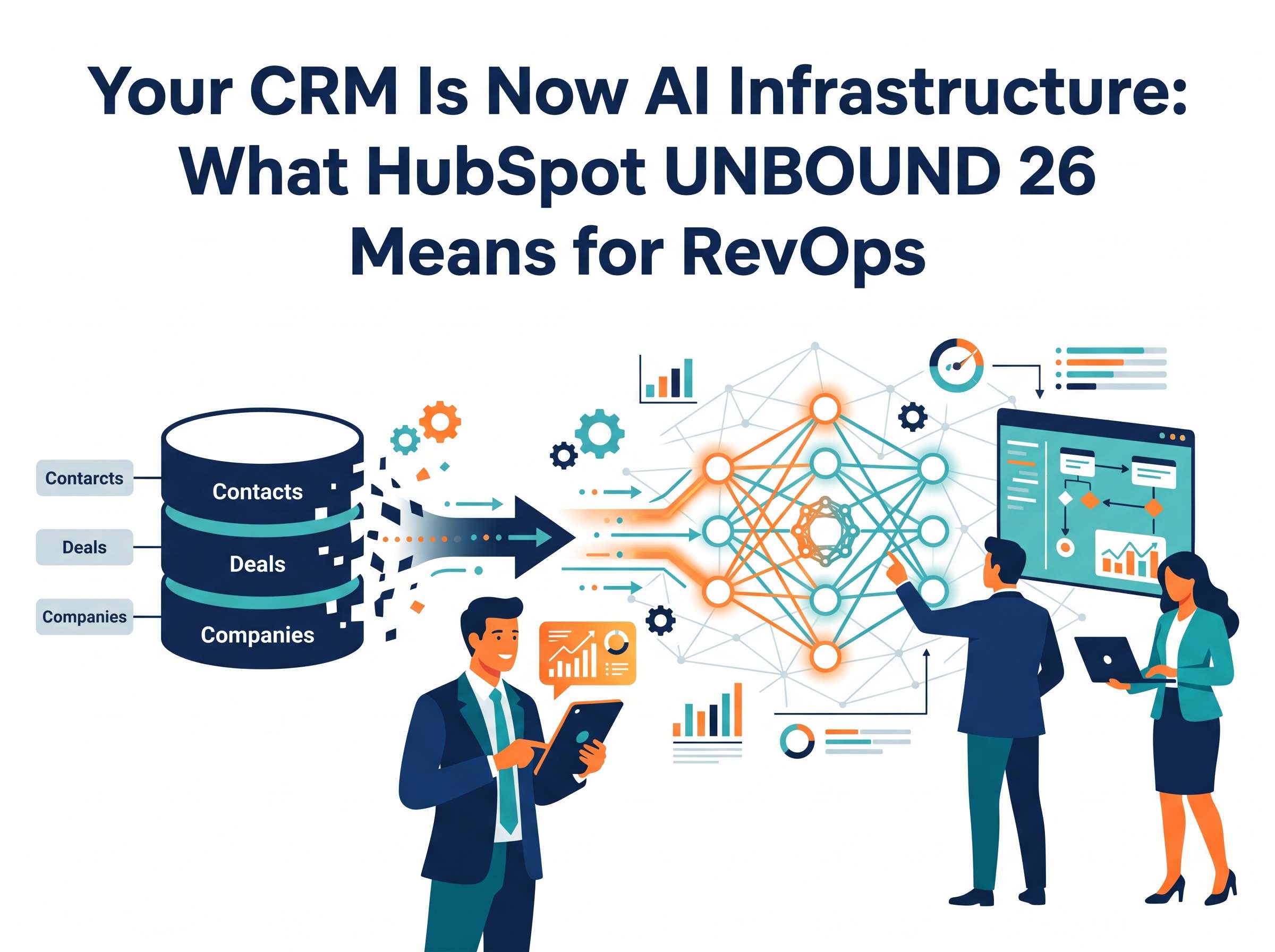
Your CRM Is Now AI Infrastructure: What HubSpot UNBOUND 26 Means for RevOps
,
HubSpot UNBOUND 26 makes RevOps more important because AI agents, automation, buyer intent, and customer-facing workflows increasingly depend on the quality of CRM data, shared business context, and process design underneath them. Context Home, Agent Hub, Buyer Intent, Data Agent, Smart CRM, and Data Hub updates all reinforce the same shift: RevOps is no longer just managing systems and reporting. It is increasingly responsible for the data, governance, context, and workflows that determine how AI operates across the business.
For years, RevOps has been the function responsible for making the revenue engine work behind the scenes.
CRM architecture. Lifecycle stages. Lead routing. Data quality. Automation. Reporting. Handoffs between marketing, sales, and service. That work has always mattered. But HubSpot UNBOUND 26 raises the stakes.
As AI becomes more embedded in how teams prospect, nurture, sell, support customers, and act on intent signals, the systems underneath those activities matter even more.
Because AI does not operate in a vacuum. It operates on context, data, rules, signals, and workflows.
Which means the quality of the RevOps foundation increasingly determines the quality of the AI sitting on top of it.
RevOps is becoming the infrastructure layer for AI
Our broader UNBOUND 26 strategy describes the Intent, Data & Revenue Intelligence cluster as the connective tissue behind agentic execution: better context, cleaner CRM data, richer intent signals, and the ability to act on them.
That framing is especially important for RevOps.
Marketing can have the best Content Agent.
Sales can have Prospecting Agent.
Service can have Customer Agent.
But if the CRM data is incomplete, lifecycle rules are inconsistent, ownership is unclear, and automation is poorly designed, those tools will inherit the same operational weaknesses the organization already had.
1. Context becomes part of the data model
One of the most important UNBOUND 26 releases for RevOps is Context Home.
HubSpot describes Context Home as a place to view and manage what HubSpot knows about the business so that teams and agents can work from the same shared context.
That may sound simple, but operationally it is a big deal.
Historically, CRM data has primarily described customers and activity.
- Who is this contact?
- What company do they work for?
- What stage is the deal in?
- What interactions have happened?
Context Home introduces another layer: What does HubSpot understand about the business itself?
That means RevOps teams now have to think not only about customer data structure, but also about the quality of the business context agents use.
If different teams define the business differently, AI-driven workflows can become inconsistent.
ICP criteria are vague, prospecting suffers.
Lifecycle definitions are unclear, automation becomes unreliable.
Brand or process context is incomplete, agents act with less useful information.
For RevOps, context becomes an operational asset.
2. Agent Hub turns AI into something that requires governance
HubSpot’s Agent Hub is another featured UNBOUND 26 product.
It gives teams a centralized place to manage agents, see what is working, understand what is possible, and take action.
Alongside it, Agent Builder allows teams to build custom agents and agentic workflows with the help of Breeze Assistant, including the ability to turn existing workflows into agentic workflows.
For RevOps, this introduces a familiar problem in a new form. Automation sprawl.
Most mature HubSpot portals already contain years of workflows.
Some are current, redundant, built for one campaign and never retired, depend on properties nobody remembers creating, overlap or conflict. Now add AI agents.
Without governance, companies can easily recreate the same operational debt they already have, just faster.
RevOps therefore needs to answer questions like:
- Who can create an agent?
- Who approves it?
- What data can it use?
- Which workflows can it influence?
- How is performance reviewed?
- What happens when an agent behaves incorrectly?
- When should an agent be retired?
- How do we avoid duplicating logic across workflows and agents?
The AI layer needs governance just as much as the CRM does. Probably more.
3. Buyer Intent changes the definition of an actionable signal
HubSpot’s UNBOUND 26 updates also significantly expand Buyer Intent.
The product roadmap includes additional buyer-intent signals, custom signals created in plain language, automatic custom signal tracking, churn-risk signals, job-change signals, and Bombora Company Surge signals.
For RevOps, the interesting part is not simply that more signals exist. It is deciding what the organization should do with them. A signal by itself has no operational value.
The value comes from what happens next.
- Should the account enter a segment?
- Should the company score increase?
- Should a sales rep be notified?
- Should an opportunity be created?
- Should marketing move the contact into a different nurture?
- Should customer success intervene because a churn-risk signal appeared?
That is where RevOps becomes essential. The function increasingly sits between data and action.
4. Custom signals create more flexibility and more responsibility
Custom Buyer Intent Signals are particularly important because HubSpot allows businesses to define signals in plain language and use them across segments, workflows, and scoring.
That gives teams flexibility, but flexibility creates governance requirements.
- What counts as high intent?
- Which behavioral signals matter?
- Which signals belong to marketing?
- Which should trigger sales action?
- Which are meaningful enough to affect scoring?
- How long should a signal remain relevant?
- What happens if multiple signals fire at once?
- When should the system suppress activity rather than create more?
Those questions are not product questions, they are operating-model questions.
And RevOps is usually the function best positioned to answer them.
5. Data Agent makes CRM information easier to query
Another important piece of the UNBOUND 26 data story is Data Agent.
HubSpot’s roadmap includes a CRM data source capability that allows users to ask a question and get answers from the full CRM without first selecting specific properties or activities.
There is also a Data Agent playground designed to let users explore the capability with live CRM records and prebuilt scenarios. For RevOps, this changes how business users may interact with CRM data.
Historically, someone with a question often needed:
- A report.
- A dashboard.
- A list.
- A custom view.
- A property filter.
- Or help from the operations team.
As natural-language access to CRM information improves, more people can potentially ask questions directly.
That is useful, but it also increases the importance of the data underneath those answers. If the CRM is poorly structured, easier access does not automatically produce better insight.
It simply makes bad data easier to query. Which brings us back to the same RevOps principle: AI makes the quality of the underlying system more visible.
6. Smart CRM reinforces the need for better data architecture
The UNBOUND 26 roadmap also contains a wide range of Smart CRM updates.
These include:
- Data model health checks
- Centralized data model management
- Real-time CRM updates
- Cross-object filtering
- Faster custom reports
- Redesigned index pages
- CRM record customization
- Improved task management
These may look like separate usability enhancements.
But for RevOps, they reinforce a broader trend: HubSpot is giving teams more ways to manage, inspect, and act on CRM structure.
If those relationships are poorly designed, automation becomes fragile. If they are well designed, teams can build more sophisticated processes without constantly creating workarounds.
7. Data Hub expands the RevOps foundation even further
Data Hub also plays an important role in the UNBOUND 26 story.
The product roadmap includes enhancements around Data Studio, merge rules, duplicate management, Snowflake sync, and BigQuery integration. That gives RevOps another layer to think about.
Customer data may no longer originate only in HubSpot.
It can come from:
- A warehouse
- Product systems
- Billing platforms
- Marketing tools
- External databases
- Support systems
- Other operational sources
The challenge is not simply getting data into HubSpot.
It is deciding:
- What belongs in the CRM?
- Which system owns the record?
- How should records be merged?
- What data needs to sync?
- What should remain external?
- How should conflicting values be handled?
- Which data should AI agents be allowed to use?
Again, those are governance questions. And ,they become more important as the system becomes more intelligent.
8. RevOps is moving from automation management to orchestration
This may be the biggest conceptual shift. Traditional RevOps has often focused on automation.
- If X happens, do Y
- If a form is submitted, route the lead
- If a deal moves stages, create a task
- If a customer reaches a threshold, notify a rep
That logic remains useful, but agentic systems introduce something broader.
- An agent may evaluate context
- Choose among possible actions
- Use data across multiple records
- Respond dynamically
- Interact with other systems
That moves RevOps from simple automation toward orchestration.
The job becomes less about building individual rules and more about designing how systems, agents, data, and humans work together. That is a much more strategic role.
9. AI governance cannot belong only to IT
It would be easy to think of AI governance as purely an IT or security concern, some of it is.
But operational governance belongs much closer to RevOps, because RevOps understands the business process.
It knows:
- How leads are routed.
- How deals progress.
- How customer stages are defined.
- How handoffs work.
- How teams use the CRM.
- Where automations intersect.
- Which data matters.
- Where exceptions happen.
That makes RevOps uniquely positioned to help define how AI should operate inside the revenue engine.
Not from a theoretical perspective. From a practical one.
What should RevOps leaders do first after UNBOUND 26?
Do not start by building agents. Start by auditing the foundation.
Look at:
- Data quality: Are core CRM properties reliable?
- Lifecycle definitions: Do marketing, sales, and service agree on stages and ownership?
- Data model: Are objects, associations, and properties structured intentionally?
- Workflow hygiene: How many existing workflows are redundant, outdated, or conflicting?
- Intent signals: Which signals genuinely require action?
- Scoring: Do scores reflect current customer behavior?
- Context: Does HubSpot have the business information agents need to work effectively?
- Permissions: Who should be allowed to build or modify automation and agents?
- Measurement: How will you know whether an agent or workflow is actually improving the process?
Only after that foundation is clear should the organization scale agentic execution.
The new RevOps mandate
UNBOUND 26 makes the RevOps role broader. The function is no longer only responsible for making the CRM work.
It increasingly has to make the system around the CRM work intelligently.
That means owning or influencing:
- Data quality.
- Context quality.
- Automation architecture.
- Signal design.
- Agent governance.
- Cross-functional processes.
- System permissions.
- Measurement.
- Continuous improvement.
The more AI becomes embedded across marketing, sales, and service, the more important RevOps becomes as the team connecting all of it.
The bigger takeaway for RevOps
HubSpot UNBOUND 26 is not just adding more AI to the CRM, it is making the CRM, its data, its context, and its workflows part of the infrastructure AI depends on.
- Context Home gives teams and agents a shared understanding of the business.
- Agent Hub and Agent Builder expand the agent layer.
- Buyer Intent creates richer signals.
- Data Agent creates new ways to interact with CRM information.
- Smart CRM and Data Hub strengthen the data and operational foundation underneath everything else.
That is why RevOps sits at the center of this shift.
The question after UNBOUND 26 is not: “How many AI agents should we build?”
It is: “Is our revenue infrastructure good enough for AI to act on it?”
That is the question RevOps should answer first.
That is the conversation we’re here to help with. Contact us here.