
HubSpot Is Becoming an AI-Powered Operating System. Here’s What That Means for Your Business
,
HubSpot’s UNBOUND 26 releases point to a broader shift in how businesses can use the platform: instead of treating AI as a collection of standalone features, companies can increasingly connect AI agents, CRM data, customer context, marketing, sales, and service inside one operating model. For business owners, that means the real opportunity isn’t simply adopting more AI. It’s deciding where AI can reduce friction, improve consistency, and help teams execute across the customer lifecycle without creating another disconnected layer of technology.
Most business leaders are not looking for another AI tool.
They are looking for answers to questions like:
- Can we grow without adding unnecessary operational complexity?
- Can our teams work from the same customer information?
- Can we automate repetitive work without losing visibility or control?
- Can marketing, sales, and service work together more effectively?
- Can AI actually improve how the business runs, rather than just helping individuals complete tasks faster?
The shift: from AI features to an AI-enabled operating model
Historically, companies have often adopted technology one problem at a time.
Marketing adds a campaign tool, Sales adds prospecting software, Service adds another support platform, Operations adds automation and then AI arrives, and another layer of tools gets added on top.
The result can be a tech stack full of individually useful products that still require people to move information between systems, reconcile context, and coordinate work manually. The direction HubSpot is taking with its latest releases is different.
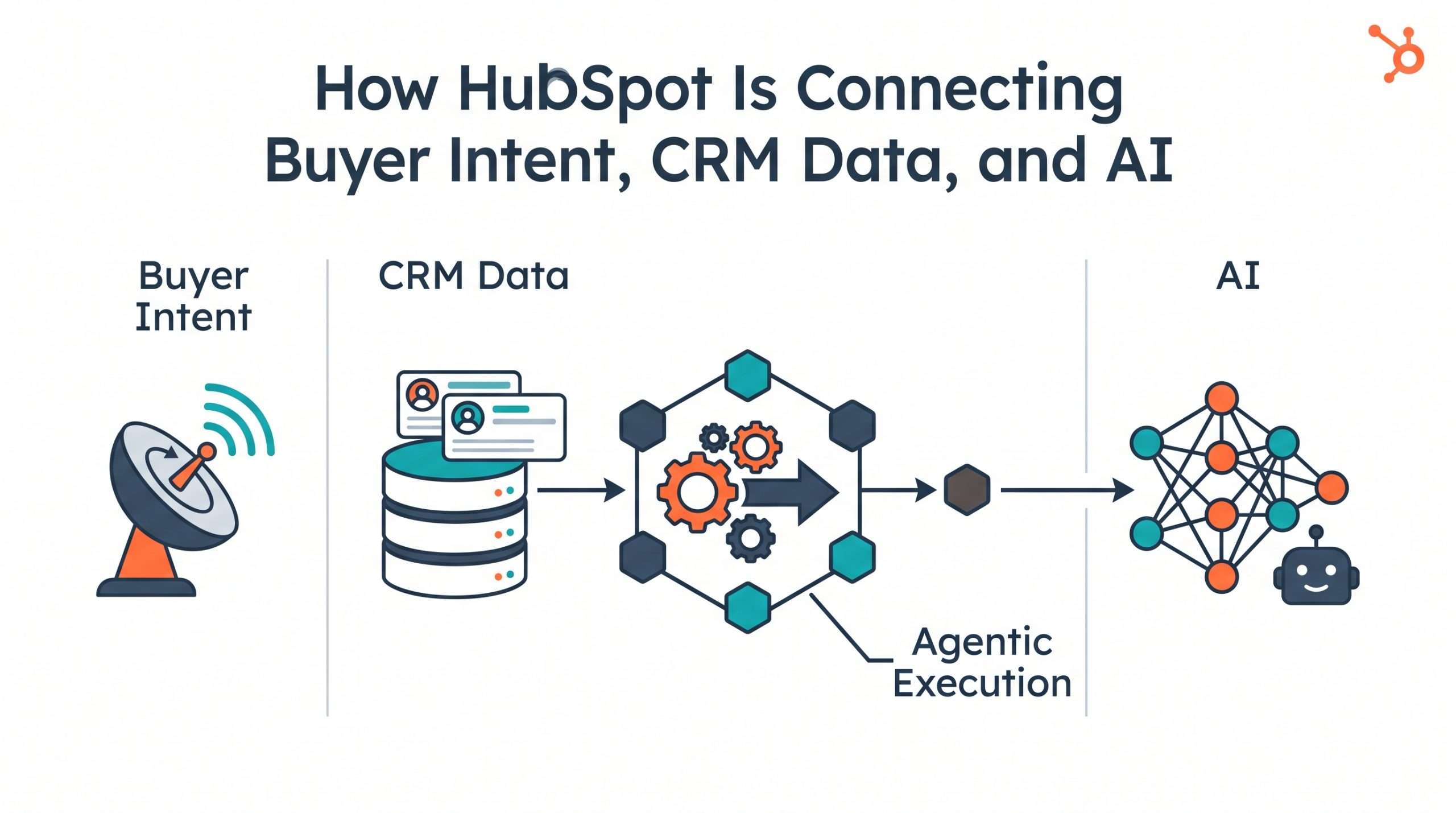
The UNBOUND 26 product roadmap connects several layers of the business:
- Context: What does HubSpot know about your company and customers?
- Data: What is happening across contacts, companies, deals, conversations, and customer activity?
- Signals: What changes or behaviors should your team pay attention to?
- Agents: What work can AI help execute?
- Human teams: Where should people make decisions, build relationships, and intervene?
1. Your CRM is becoming more than a system of record
A CRM has traditionally answered a fairly simple question:
- What happened?
- Who filled out a form?
- What deal is open?
- When did we last speak with this customer?
- What ticket did they submit?
Those records remain important, but HubSpot is increasingly using CRM information as context for AI-driven work.
One of the clearest examples is Context Home, a featured UNBOUND 26 product designed to let businesses view and manage what HubSpot knows about the organization in one place so teams and agents can work from shared context. For a business owner, the implication is bigger than easier administration.
If your CRM contains the context that marketing, sales, service, and AI agents rely on, then CRM quality becomes a business-level issue.
Your customer data is no longer just something people reference, it becomes part of the infrastructure determining how automated systems act. That raises a new executive question: Do we trust the information our business is running on?
If the answer is no, AI adoption alone will not solve the problem.
It makes CRM strategy, data quality, lifecycle definitions, ownership, and governance more important — not less.
2. AI agents are moving from experiments into actual workflows
One of the most significant UNBOUND 26 developments is the expansion of HubSpot’s agent ecosystem.
Agent Hub gives teams a centralized place to manage agents and understand what is running across the business, while Agent Builder allows companies to build custom agents and agentic workflows with the help of Breeze Assistant. HubSpot can also turn existing workflows into agentic workflows.
That changes the conversation from: “Can AI help someone complete this task?” to: “Can we redesign this workflow so the system handles part of it consistently?” That is a much more meaningful question for a business owner.
That could mean helping teams research prospects, move opportunities forward, respond to routine customer inquiries, personalize nurture, identify signals, or coordinate work around CRM information.
The executive opportunity is therefore not simply AI adoption, it is workflow redesign.
3. Marketing can become a connected growth system instead of a collection of campaigns
Marketing is another good example of this shift.
HubSpot describes Marketing Studio 2.0 as a unified marketing workspace where insights drive campaigns, campaigns drive outreach, and results feed back into what the team does next. The stated goal is to help teams increase reach, influence more deals, and scale without adding additional headcount or point solutions.
That is important from an executive perspective because the conversation changes from: How much content did marketing create? to: Is marketing operating as a system that learns from what is working?
Supporting products reinforce that model. Content Agent is designed to research brand voice, audience data, and the competitive landscape before generating assets such as blog posts, LinkedIn content, and landing pages. Nurture Agent uses CRM data, engagement signals, and live research to personalize nurture emails.
For a business owner, that is a more useful way to think about AI in marketing: not “Can AI make more content?” but “Can our marketing engine become more responsive and repeatable?”
4. Sales AI is moving closer to the revenue process
Sales leaders have spent years buying tools intended to save reps time. UNBOUND 26 pushes AI further into the sales motion itself.
Prospecting Agent, another featured product, can source contacts from data providers, support prospecting outreach, and learn from rep edits while matching the organization’s brand voice.
Further down the funnel, Deal Progression is designed to help keep opportunities moving between conversations with recommended next steps, CRM updates, and inbox follow-ups.
Instead of relying entirely on every rep to remember the next step, perform research manually, update every record, and maintain follow-up discipline independently, AI can increasingly support the process around them.
That creates a different management question: Where does human judgment create the most value, and where are we currently paying people to perform repetitive administrative work?
5. Customer service automation is becoming much more configurable
Customer-facing AI is also becoming more operationally sophisticated.
HubSpot’s Customer Agent roadmap now includes capabilities around handoff, routing, audience targeting, actions, knowledge, testing, coaching, segmentation, reporting, and voice.
For example, businesses can define guidelines for when Customer Agent should hand a conversation to a human, personalize the agent by customer segment, generate draft knowledge from resolved support tickets, test responses before deployment, and review performance after launch. For an owner, this is an important evolution.
The decision is no longer: Do we use a chatbot?
It becomes: Which customer interactions should be automated, how should the system behave, and where does a human need to step in?
That is an operating-model question, and it requires ownership.
Someone must decide which customer experiences are appropriate for automation, how quality is measured, how exceptions are handled, and when the process should change.
6. Signals can increasingly trigger action across the business
Another important layer is HubSpot’s expansion of buyer-intent capabilities.
UNBOUND 26 includes additional intent signals, custom signals that businesses can define in plain language, automated tracking, churn-risk signals, job-change signals, and Bombora Company Surge signals. The important word here is signals.
Most businesses already have an enormous amount of customer information.
The problem is rarely that absolutely no data exists, it’s identifying what matters and doing something with it quickly enough.
A signal-driven operating model looks different from a static one.
A company shows increased intent. A customer demonstrates churn risk. A stakeholder changes jobs. A deal needs a follow-up. A service interaction reveals something important. The opportunity is to connect those events with workflows, segmentation, scoring, agents, and human action.
For business owners, that means the CRM can become less about storing history and more about helping teams recognize when something requires attention.
7. The biggest opportunity may be fewer disconnected systems
There is another implication here that deserves executive attention: technology consolidation.
The more marketing, sales, service, automation, customer context, AI agents, and CRM data can operate within one connected environment, the more companies can question whether every existing point solution still earns its place.
That does not mean every company should immediately rip out its tech stack.
It does mean UNBOUND 26 creates a useful moment to ask:
- What tools duplicate capabilities we now have in HubSpot?
- Where are teams manually moving information between systems?
- Where does context get lost?
- Which integrations exist only because two departments operate in separate platforms?
- Where are we paying for software because our core system could not previously perform the job?
Those are cost questions, but they are also operational questions. Every additional tool creates another place for data, permissions, reporting, process, and adoption to drift. Consolidation only makes sense when the core platform can genuinely support the business requirement, but it is a conversation worth reopening.
What should a business owner actually do after UNBOUND 26?
The wrong response is probably to turn on every new AI capability at once. The better response is to identify where the business is experiencing the most friction.
Start with questions like:
- Where are employees spending significant time on repetitive work?
- Where are handoffs between departments breaking down?
- Where do leads, deals, or customers fall through the cracks?
- Where does poor CRM data create operational problems?
- Where are employees switching between multiple tools to complete one workflow?
- Which customer interactions are highly repeatable?
- Which workflows have clear inputs, clear rules, and a measurable outcome?
- Where would faster access to context materially improve decision-making?
Then work backward into the technology.
That keeps the conversation centered on the business problem rather than the newest feature.
AI strategy now requires ownership and governance
As HubSpot becomes more agentic, another responsibility moves closer to leadership: governance.
Someone needs to decide:
- Who can build agents?
- Which workflows should agents be allowed to influence?
- What customer context should they use?
- How are outputs reviewed?
- What happens when an agent is wrong?
- Which interactions require human approval?
- How will the company measure whether the automation is actually improving performance?
The technology may make automation easier to deploy. That does not remove the need for operational discipline. In many ways, it increases it.
The companies that get the most value from agentic systems will likely be the ones that treat them as part of the operating model rather than a side experiment owned by one enthusiastic employee.
The bigger takeaway from HubSpot UNBOUND 26
The most useful way for business leaders to interpret UNBOUND 26 is not as a list of product announcements.
It is as a signal of where HubSpot is taking the platform.
The CRM remains the foundation, but around it HubSpot is building more ways to manage shared context, identify meaningful signals, create and manage AI agents, automate work, support teams, and coordinate activity across the customer lifecycle. The UNBOUND 26 content strategy is intentionally organized around those business outcomes rather than HubSpot’s product menu for exactly that reason.
For business owners, the question is therefore not: “Which HubSpot AI features should we turn on?”
It is: “Where does our business need to operate differently and can HubSpot now help us redesign that part of the system?”
That is the conversation we’re here to help with. Contact us here.