
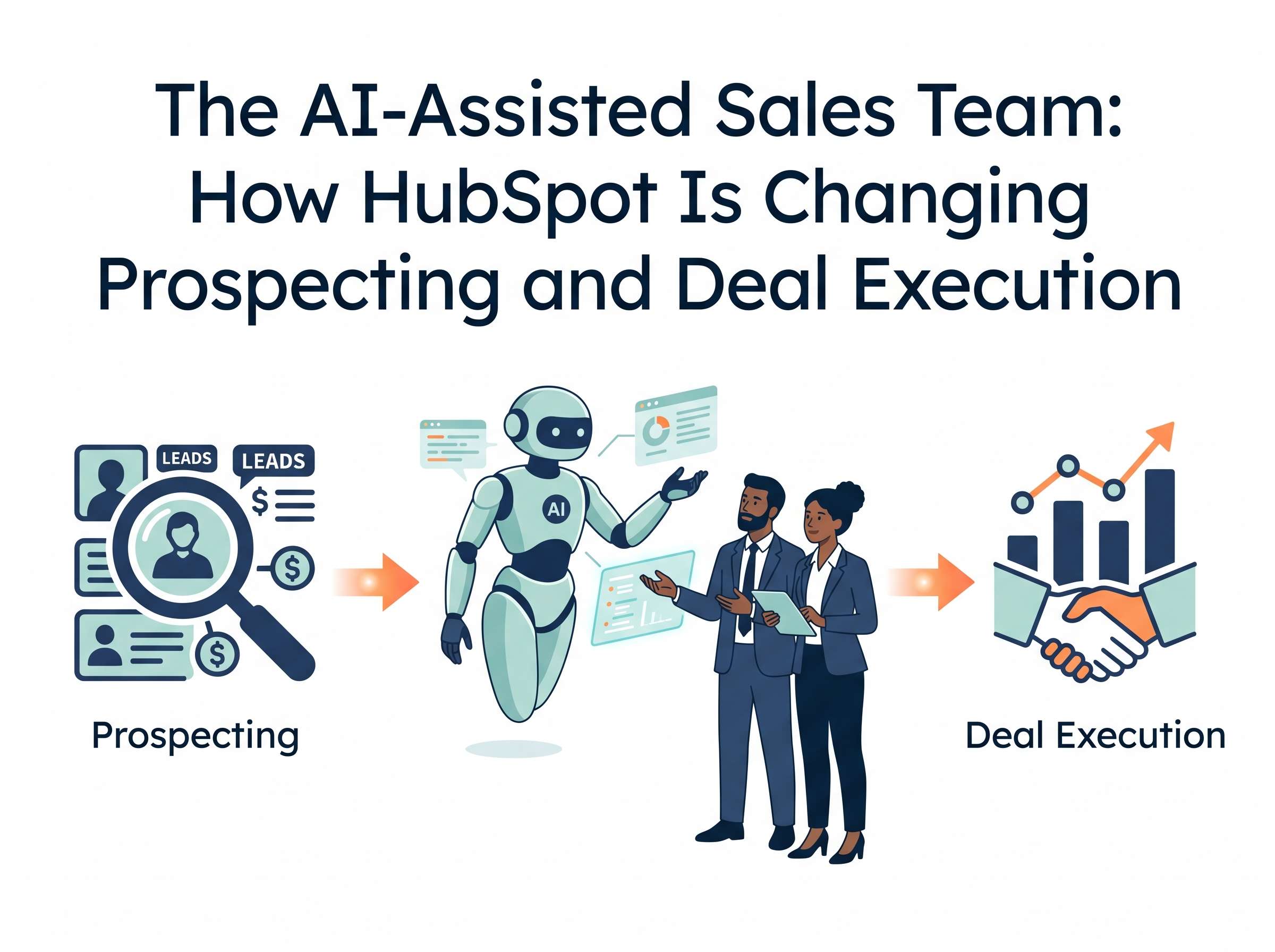
The AI-Assisted Sales Team: How HubSpot Is Changing Prospecting and Deal Execution
,
HubSpot UNBOUND 26 changes sales by bringing AI deeper into the seller workflow, from finding and engaging prospects to understanding buying groups and advancing deals. Prospecting Agent helps teams source and engage contacts, Buying Groups helps sellers map stakeholders and identify deal risk, and Deal Progression supports next steps, CRM updates, and follow-up between conversations. For sales leaders, the opportunity is to build a more consistent sales process where AI handles more of the repetitive research and administrative work surrounding reps while sellers stay focused on relationships, judgment, and closing.
Sales leaders have heard the productivity pitch before. Give reps better data. Automate outreach. Reduce admin. Improve CRM hygiene. Help sellers spend more time selling.
None of those ideas are new.
What is changing is how much of that work AI can now participate in across the sales process itself.
HubSpot’s UNBOUND 26 sales releases point toward a model where AI can help teams identify prospects, understand the people involved in a deal, support outreach, capture customer conversations, recommend next steps, and keep CRM records more current.
That creates a bigger question for sales leadership: What happens when AI becomes part of the sales process, rather than another tool reps have to remember to use?
The sales motion is becoming more connected
Our broader UNBOUND 26 content strategy organizes the sales story around a simple seller journey: find the right buyer → understand the buying committee → engage → advance the deal.
Sales technology has traditionally fragmented those steps: One tool helps with prospecting. Another provides data. Another manages sequencing. A rep takes notes somewhere else. Managers review pipeline in the CRM. Follow-up depends on the individual seller.
The opportunity with HubSpot’s latest releases is to bring more of those activities into one connected sales motion. And for sales leaders, that is more important than any single feature.
1. Prospecting Agent brings AI closer to top-of-funnel execution
At the beginning of the sales process, HubSpot’s Prospecting Agent is one of the featured UNBOUND 26 products.
According to HubSpot’s Spotlight materials, Prospecting Agent can source contacts on demand from data providers, send emails that improve with every rep edit, and match brand voice to prospecting plays.
The obvious benefit is efficiency. Reps can spend less time manually sourcing contacts and drafting every outreach message from scratch. But the bigger implication for sales leaders is consistency.
Traditional prospecting often depends heavily on the individual rep. Some research thoroughly, personalize every message, rely on templatesfollow the process. Some do not.
AI-assisted prospecting gives leaders an opportunity to standardize more of the groundwork around the seller. That does not mean every prospect receives identical outreach. It means the organization can create a more consistent foundation for how research, messaging, and prospecting are executed.
The leadership question becomes: What parts of our prospecting process should depend on rep creativity, and what parts should become repeatable?
2. Buying Groups reflect how B2B deals actually happen
Sales processes often look cleaner in the CRM than they do in reality. A deal might have one primary contact associated with it.
But the actual buying decision can involve: Finance. IT. Operations. A department leader. An executive sponsor. Procurement. Legal. End users.
That is why HubSpot’s Buying Groups update matters. The UNBOUND 26 roadmap shows Breeze Assistant helping sellers build buying groups faster, map stakeholders, and identify potential deal risk. For sales leaders, this moves an important part of deal strategy closer to the system.
Instead of asking only: “Who is the contact on this opportunity?”
teams can think more deliberately about: “Who actually needs to be involved for this deal to move?”
That can change how managers coach opportunities.
- Are we single-threaded?
- Do we have an executive sponsor?
- Who is influencing the decision?
- Who could block it?
- Who has not yet been engaged?
Those questions already exist in strong sales organizations. The opportunity is to make that thinking more systematic.
3. AI can support what happens between sales conversations
A huge amount of sales work happens between meetings.
Someone needs to:
- Write the follow-up.
- Update the CRM.
- Record the next step.
- Capture what was discussed.
- Create a task.
- Send requested information.
- Schedule another conversation.
- Remember what the buyer committed to.
- Keep the opportunity moving.
HubSpot’s featured Deal Progression capability is designed to help keep deals moving between conversations with recommended next steps, CRM updates, and inbox follow-ups.
For years, sales leaders have tried to solve follow-up consistency through process enforcement. Update the CRM. Enter your next step. Complete your tasks. Log your activity.
Now AI can increasingly support some of that operational work around the seller. The goal is not simply to make reps more efficient. It is to reduce the likelihood that good opportunities stall because routine execution was missed.
4. Notetaker helps capture more of what happens in customer conversations
The UNBOUND 26 roadmap also includes Notetaker with Deal Progression.
HubSpot positions it as a way to prepare for and capture customer conversations, review suggested follow-ups, and keep deal records up to date after interactions. There is also a mobile version designed to capture in-person meetings and allow reps to review transcripts, summaries, and follow-up actions afterward.
For sales leaders, this matters because customer conversations contain some of the most valuable information in the sales process.
- Objections.
- Priorities.
- Timelines.
- Internal politics.
- Concerns.
- Commitments.
- Questions.
Traditionally, that context depends on how well the rep documents it.
If more of that information can be captured and connected back to the CRM, managers have the potential to coach from a stronger record of what actually happened.
Again, the important shift is not the feature itself. It is what happens when the conversation, CRM record, and next action become more connected.
5. The real opportunity is sales-process consistency
Most sales leaders do not have a strategy problem. They know what good selling looks like.
The harder problem is getting the process executed consistently across the team.
- Research the account.
- Identify the right contacts.
- Understand the buying committee.
- Prepare for the meeting.
- Document the conversation.
- Follow up quickly.
- Keep the CRM current.
- Define the next step.
- Move the opportunity forward.
Great reps often do these things naturally. But scaling that behavior across an entire sales organization is difficult. That is where AI can become strategically useful.
Not because it replaces good sellers. Because it can help support the habits around good selling.
The question for leaders becomes: Which parts of our sales process are too dependent on individual memory and discipline today? Those are some of the best places to evaluate AI assistance.
6. AI does not eliminate the need for sales judgment
There is also a line sales leaders should be careful not to cross.
AI can help with research. It can help with follow-up, support recommendations, surface context, capture conversations and organize information.
But many of the highest-value parts of selling still require human judgment.
- Should we push this deal or give the buyer space?
- Is this objection real, or is something else happening internally?
- Who actually has influence?
- Does this customer trust us?
- Should we bring an executive into the conversation?
- Is the opportunity genuinely qualified?
- What is not being said?
Those decisions are contextual and relational. The opportunity is therefore not to remove the seller from the process.
It is to remove more of the work that prevents the seller from doing that work well.
7. Sales management may become more about exceptions
There is another interesting implication here for managers.
Traditional sales management often involves reviewing large amounts of activity and pipeline information to figure out where attention is needed.
- What deals are stalled?
- Which reps are behind?
- Where is follow-up missing?
- Which opportunities are at risk?
As AI becomes more involved in identifying next actions and surfacing deal context, managers may increasingly be able to focus on exceptions.
- The deal where multiple stakeholders are missing.
- The opportunity with unclear next steps.
- The account that has gone quiet.
- The rep who needs coaching.
- The late-stage deal with risk signals.
In other words, management can potentially shift from checking whether every routine action happened to spending more time on the situations that actually require judgment.
That is a much better use of a sales leader’s time.
8. The CRM becomes more valuable when reps do less manual CRM work
Every sales leader knows the tension. You need accurate CRM data. Reps hate updating the CRM. Leadership needs visibility. Reps want to sell. That tension has existed forever.
AI-assisted CRM updates create the possibility of reducing some of that friction. Deal Progression can support CRM updates. Notetaker can capture customer conversations. Buying Groups can help structure stakeholder information. Prospecting Agent can connect outreach more closely with the sales process.
The more the CRM can be updated as a byproduct of the sales process itself, the less leaders have to choose between rep productivity and reporting accuracy.
That does not mean CRM governance disappears. It means the process of maintaining the system can become more embedded in the work.
What should sales leaders do first?
The wrong move is to begin with a feature list. Instead, map the parts of the sales process where execution is inconsistent.
Look at:
- Prospecting: How much time do reps spend finding contacts and researching accounts?
- Buying committees: How often are deals dependent on one contact?
- Outreach: How consistent is personalization and messaging?
- Meetings: How much customer context gets lost after conversations?
- Follow-up: How quickly and consistently do reps act after meetings?
- CRM updates: Where does manual data entry break down?
- Deal progression: How often do opportunities stall because the next action is unclear?
- Manager coaching: Do managers have enough context to coach the deal effectively?
Then ask where AI can improve the process without removing the human judgment that makes the sale successful.
That is a much more productive starting point than simply telling every rep to “use AI.”
How does the sales leader’s role change?
AI-assisted sales creates a new leadership responsibility: designing the relationship between the seller and the system.
Sales leaders will increasingly need to decide:
- Which prospecting tasks should be automated?
- Where should reps review AI-generated outreach?
- What information should define a buying group?
- Which recommendations should sellers trust automatically?
- When should managers intervene?
- How should reps handle AI-generated next actions?
- What does good CRM hygiene look like when more updates happen automatically?
- How will the team measure whether AI is improving sales outcomes?
That makes AI adoption a sales-process question, not just a technology question.
The bigger takeaway for sales leaders
HubSpot UNBOUND 26 points toward a more AI-assisted sales motion. Prospecting Agent helps teams find and engage buyers. Buying Groups helps sellers understand who is involved. Notetaker helps capture the conversation. Deal Progression helps support the work required to keep the opportunity moving.
Together, they align with the broader seller journey defined in our UNBOUND 26 content strategy: find the right buyer → understand the buying committee → engage → advance the deal.
For sales leaders, the goal should not be to automate selling.
It should be to make the sales process more consistent around the seller.
The question worth asking after UNBOUND 26 is: Where are our reps spending time on work that the system could handle — and what would they do differently if they got that time back? That is where AI starts becoming useful to the revenue organization.
That is the conversation we’re here to help with. Contact us here.