
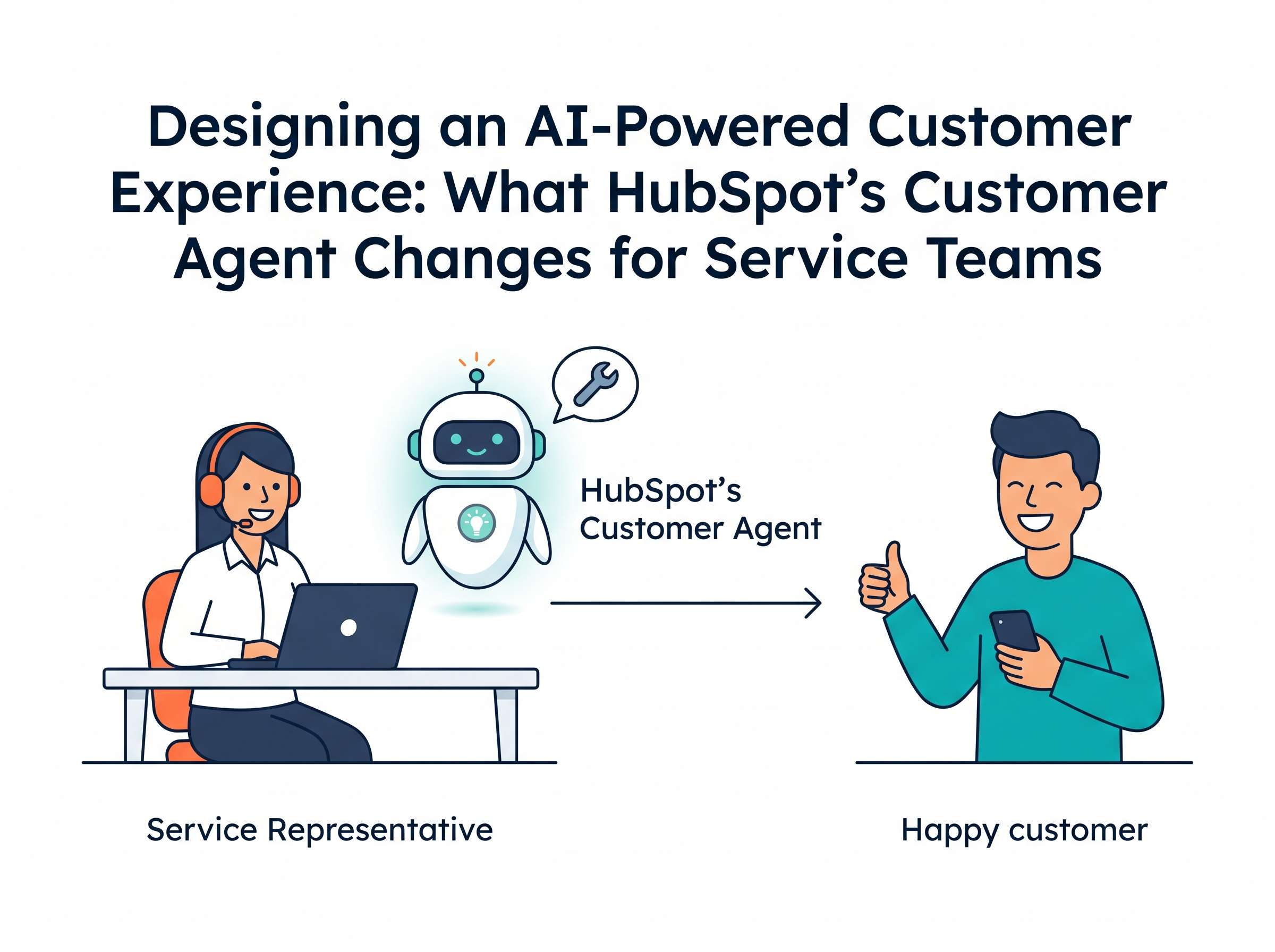
Designing an AI-Powered Customer Experience: What HubSpot’s Customer Agent Changes for Service Teams
ther ,
HubSpot UNBOUND 26 changes customer service by turning Customer Agent into a more configurable part of the service operating model. Service teams can control who Customer Agent engages with, define when it should hand conversations to humans, personalize responses by audience segment, generate knowledge from resolved tickets, test and coach responses, measure performance, and expand support across channels including voice. For customer success and service leaders, the opportunity is not simply to automate more conversations. It is to intentionally design which interactions AI should handle, where humans should step in, and how the experience improves over time.
For years, customer-service automation has largely been framed around one question: How many tickets can we deflect?
It is an understandable goal. Support teams are under pressure to respond faster. Customers expect immediate answers. Hiring additional service reps is expensive. And a significant percentage of support conversations are repetitive.
But that framing misses the bigger opportunity behind HubSpot’s UNBOUND 26 service releases.
Customer Agent is evolving beyond a simple automated responder.
HubSpot’s Fall Spotlight roadmap expands Customer Agent across setup, routing, targeting, handoff, actions, knowledge, testing, coaching, segmentation, reporting, channels, and voice.
That turns the conversation from: “Should we use AI in support?”
into: “How should AI participate in our customer experience?”
For customer success and service leaders, that is a much more strategic question.
Customer Agent is becoming part of the service operating model
A basic chatbot follows a relatively simple model: A customer asks a question. The bot tries to answer. If it cannot, hopefully the customer reaches a person. Customer Agent is moving toward something more configurable.
HubSpot’s UNBOUND 26 roadmap includes capabilities that allow teams to determine:
- Who the agent talks to.
- Where it is deployed.
- What knowledge it uses.
- Which actions it can take.
- When it should hand off.
- How it should behave for different audiences.
- How its responses are tested.
- How teams can coach it.
- How performance is measured.
- What happens when human intervention is required.
And that means service leadership needs to be involved in how the system is designed.
1. The first question is not “What can we automate?”
The temptation with any new AI capability is to begin with volume.
- How many conversations can Customer Agent handle?
- How many tickets could it resolve?
- How much could we reduce support workload?
The better starting point is: Which customer interactions are appropriate for AI?
A straightforward product question may be a great fit, repetitive account question may be a great fit or a customer who is angry, confused, at risk of leaving, or dealing with an unusual situation may need a person.
The goal should not be maximum automation, it should be appropriate automation.
2. Handoff design becomes part of customer-experience strategy
One of the most important areas of Customer Agent’s expansion is handoff.
HubSpot allows teams to establish guidelines so Customer Agent knows when to transfer conversations to a human rep. Teams can also assign conversations to Customer Agent from Help Desk or Inbox and use fallback routing when human agents are unavailable.
One of the biggest risks of automated service is not that AI answers easy questions, it is that AI continues trying to answer when a human should have taken over.
A strong service operation therefore needs explicit handoff rules.
- When should frustration trigger escalation?
- Which topics require a human?
- Which customers should receive different treatment?
- When should an agent stop attempting to resolve the issue?
- What happens if no service rep is immediately available?
- What information should follow the customer into the human conversation?
These are service-design questions. And the quality of the handoff may matter just as much as the quality of the AI response.
Customers generally do not care whether an internal process is “AI-powered.” They care whether their problem gets resolved.
3. AI service does not have to mean the same experience for every customer
Another meaningful Customer Agent development is audience segmentation.
HubSpot’s Fall Spotlight roadmap includes the ability to personalize Customer Agent for different customers using segments so the agent can adapt its experience by audience. That opens up a more sophisticated approach to automated service.
Because customers are not identical.
- A new customer may need more explanation.
- A long-term customer may already understand the basics.
- An enterprise account may require a different support process.
- A customer in onboarding may need different answers than one approaching renewal.
Different products, customer tiers, lifecycle stages, or service models may require different treatment.
Service leaders therefore need to think about personalization beyond simply inserting someone’s name into a response.
The more useful question is: What context should change the way this customer is supported?
That is where CRM data and customer-service strategy start becoming much more connected.
4. Your support history can become part of the knowledge system
Customer Agent also now has the ability to generate draft knowledge from resolved support tickets for teams to review and approve. This is an important operating-model change.
Every support organization already contains an enormous amount of knowledge.
The problem is that much of it is trapped inside:
- Resolved tickets.
- Agent responses.
- Email conversations.
- Internal messages.
- Experienced employees’ heads.
As a result, teams repeatedly solve the same problems. And when documentation exists, it can quickly become outdated.
Using ticket history to generate draft knowledge creates an opportunity to turn the service operation itself into a source of reusable knowledge.
That creates a useful loop: Customers ask questions → service resolves them → recurring knowledge is captured → Customer Agent gains better approved knowledge → future customers can get better answers.
But there is an important word in that process: approved.
The roadmap describes generated knowledge as drafts that teams can review before Customer Agent uses them. Human oversight still matters.
5. Testing AI before customers encounter it should become standard
Most service leaders would never deploy a completely new support process without testing it. AI should not be treated differently.
HubSpot’s Customer Agent roadmap includes both an embedded tester and batch testing.
The embedded tester allows teams to test responses while editing the agent, while batch testing lets teams evaluate Customer Agent against real customer questions before going live and then coach it based on the results.
That creates a much healthier model for AI deployment.
Instead of: Build → launch → hope
service teams can move toward: Configure → test → review → coach → deploy → measure → improve
That sounds obvious, but it is an important shift in how organizations should think about customer-facing AI.
Customer Agent should not be treated as software that gets configured once and forgotten.
It should be treated as something the team manages continuously.
6. Service leaders increasingly need to coach AI alongside people
The idea of coaching is particularly interesting.
Managers already coach service reps. They review conversations. Identify where answers went wrong. Reinforce best practices. Improve tone. Clarify processes. Share better resources.
Customer Agent introduces another participant that requires similar attention.
HubSpot’s roadmap includes Customer Agent insights in Help Desk that allow teams to review the sources and reasoning behind replies so they can coach and improve answers.
That means service quality management expands.
Leaders are no longer responsible only for: How are our human agents performing?
They also need to ask:
- How is our AI agent performing?
- Where does it struggle?
- Which questions produce weak responses?
- Is it using the right knowledge?
- Are handoffs happening appropriately?
- Do certain topics require better guidance?
- Are particular customer segments getting the experience we intended?
That makes AI coaching part of the service-management discipline.
7. Customer Agent performance needs to be measured like any other service channel
HubSpot has also expanded Customer Agent reporting so teams can better see and report on performance.
That is important because automation can look successful when measured too narrowly. Imagine Customer Agent handles a large percentage of conversations. Great.
But what if:
- Customers repeatedly ask the same question?
- Humans have to reopen many conversations?
- Escalations happen too late?
- The answers technically resolve tickets but create frustration?
- Important customer issues get missed?
Volume alone does not tell you whether the experience is working.
Service leaders should think about Customer Agent alongside broader service metrics.
- Resolution.
- Escalation.
- Reopen rates.
- Human intervention.
- Customer experience.
- Recurring topics.
- Knowledge gaps.
- And, where appropriate, retention or expansion signals.
8. Customer Agent is expanding beyond chat
Another important UNBOUND 26 development is channel expansion.
The roadmap shows Customer Agent operating across multiple customer touchpoints, including chat, email, forms, and voice. The voice capability is designed to let Customer Agent answer customer calls and hand conversations to a representative when needed.
That matters because customers do not experience a company through organizational charts, they experience it through interactions.
They may send an email today. Use chat tomorrow. Call next week. Submit a form later.
If AI becomes involved across multiple channels, service leaders need to think about the consistency of the experience, not just how each channel works individually.
- Does the agent have the right context?
- Does the customer have to explain everything again?
- Are escalation rules consistent?
- Does a human rep understand what happened before the handoff?
- Do different channels produce different answers?
Omnichannel AI makes orchestration more important.
9. Customer success leaders should pay attention too
This is not only a support story.
HubSpot’s service roadmap also includes Customer Success Revenue Reporting that allows teams to track measures such as gross and net revenue retention, renewal pipeline, and book-of-business value, alongside Product Usage Tracking designed to help teams define and monitor customer adoption.
That creates a broader customer-success opportunity.
Service interactions can produce important signals.
A customer asking the same question repeatedly may indicate an adoption problem.
A change in product usage may deserve attention.
A difficult conversation may reveal churn risk.
HubSpot’s Buyer Intent roadmap also includes churn-risk signals derived from customer emails, calls, and notes.
For Customer Success leaders, the larger opportunity is to connect: support activity + customer context + product usage + revenue + risk
Instead of treating those as separate operational worlds.
That is where customer AI starts becoming part of retention strategy, not simply ticket reduction.
10. The goal should be better human attention
There is an important philosophical shift buried underneath all of this.
Automation is often sold as a way to remove humans. A healthier approach is to ask whether automation can make human attention more valuable.
If Customer Agent can resolve repetitive questions, service reps can spend more time on situations that require empathy, judgment, investigation, or relationship management. Another use case, if AI can surface context before the handoff, the rep can spend less time figuring out what happened or recurring questions can improve the knowledge base, the whole team becomes more effective. Or, if risk signals appear earlier, Customer Success can intervene sooner.
The objective is not necessarily fewer human interactions. It can be better human interactions where they matter most.
What should service leaders do first?
Do not begin by asking Customer Agent to handle everything.
Start by mapping the customer experience.
Look at:
- Conversation volume: Which questions occur repeatedly?
- Complexity: Which interactions are straightforward versus highly contextual?
- Risk: Which conversations should always involve a human?
- Knowledge: Are current answers documented and trustworthy?
- Handoff: When should AI stop and a person begin?
- Segments: Do different customer groups require different experiences?
- Channels: Where are customers currently contacting you?
- Quality: How will you test responses before launch?
- Coaching: Who owns improving Customer Agent over time?
- Measurement: How will you know whether automation is actually improving the experience?
Then choose an initial use case where the outcome is clear and measurable. Expand from there.
The service leader’s role is becoming experience orchestration
There is a pattern across all of the UNBOUND 26 role-based changes.
Marketing leaders increasingly design the marketing system. Sales leaders increasingly design the relationship between sellers and AI. RevOps increasingly designs the infrastructure. And service leaders increasingly need to orchestrate the customer experience across humans and AI.
That means deciding:
- What AI owns.
- What humans own.
- Where they collaborate.
- When escalation happens.
- What context follows the customer.
- What knowledge AI can use.
- How AI is tested.
- How it gets coached.
- How performance is measured.
That is significantly broader than managing a support queue.
The bigger takeaway for Customer Success and Service leaders
The Customer Agent story coming out of UNBOUND 26 is not simply that HubSpot has a better chatbot.
It is that Customer Agent is becoming a configurable part of the service organization.
Teams can control who it engages with. Define handoffs. Personalize experiences by segment. Give it approved knowledge. Test it before deployment. Coach it after launch. Measure performance. Deploy it across more channels. And connect customer interactions with broader customer-success information.
That is why our UNBOUND 26 content strategy treats Customer Agent as one of the largest product sub-clusters: its expansion reaches across setup, routing, targeting, handoff, actions, knowledge, testing, coaching, segmentation, reporting, channels, and voice.
For service leaders, the question after UNBOUND 26 should not be: “How many conversations can we automate?”
It should be: “What should the ideal customer experience look like when AI and humans are working together?”
Design that first. Then automate around it.
That is the conversation we’re here to help with. Contact us here.