
How HubSpot AI Is Changing Sales: Prospecting Agent, Deal Progression, and Buying Groups
,
HubSpot AI is changing sales by supporting more of the seller journey inside one connected CRM: Prospecting Agent helps teams identify, research, and engage the right prospects; Buying Groups helps sellers understand the stakeholders involved in a purchase; and Deal Progression uses deal context to recommend next steps, suggest CRM updates, and help reps keep opportunities moving. Together, these capabilities move HubSpot AI beyond isolated sales productivity tools toward an AI-assisted sales process that follows the buyer from prospecting through active deal progression.
That is the larger sales story behind HubSpot’s UNBOUND 26 releases.
Sales teams have been using AI for years to write emails, summarize calls, and perform individual tasks faster. HubSpot’s newer sales capabilities point toward something more connected.
The system can increasingly help a seller answer four different questions at four different moments:
- Who should I be talking to?
- Who else matters in this purchase?
- How should I engage them?
- What should happen next to move this deal forward?
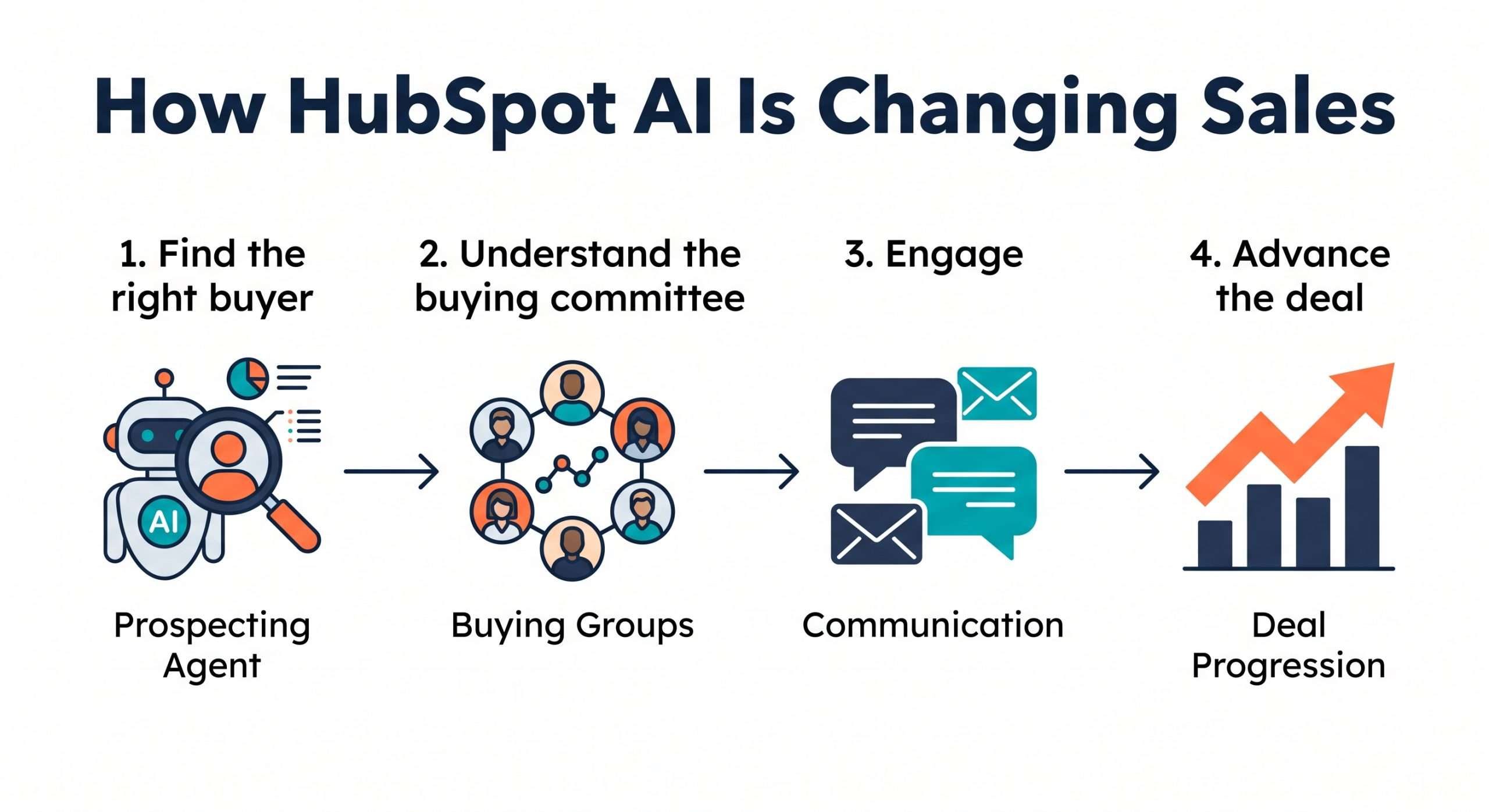
That maps directly to the seller journey at the center of HubSpot’s agentic sales strategy: find the right buyer → understand the buying committee → engage → advance the deal.
Prospecting Agent and Deal Progression are the featured anchors at either end of that motion. Buying Groups provides greater visibility into the people and relationships between those stages.
And when those capabilities work from the same CRM, the bigger opportunity becomes clear: reduce the time sellers spend researching, reconstructing context, updating records, and figuring out the next administrative step so they can spend more time actually moving the sale forward.
What does agentic sales mean in HubSpot?
Agentic sales in HubSpot means using AI to support defined parts of the selling process using the customer and deal information already available in the CRM.
Prospecting Agent can research prospects and execute outreach strategies. Buying Groups can help sellers map the people involved in a purchase and understand their relationships. Deal Progression can analyze deal activity to surface recommended next steps and CRM updates.
Each capability addresses a different point in the revenue process, the connection between them is what makes the model more interesting. A seller should not have to start over every time a prospect moves into a different stage of the buying journey.
The intelligence gathered during prospecting can live alongside the contacts, companies, activities, and deals that sellers already manage inside HubSpot. That makes the CRM more than a place where reps record what happened.
It can increasingly help them determine what to do next.
Step 1: Find the right buyer with HubSpot Prospecting Agent
The seller journey starts before the first email is sent.
First, the team needs to determine who is worth engaging.
That is where HubSpot Prospecting Agent becomes one of the most important sales releases in UNBOUND 26.
HubSpot’s Fall Spotlight update positions Prospecting Agent around three major capabilities: sourcing contacts from data providers, generating outreach that improves from rep edits, and matching brand voice to prospecting plays. The feature is marked as a Featured Product and generally available as of September 16, 2026.
HubSpot’s product documentation describes Prospecting Agent as a way to enroll contacts for research and have the agent execute an outreach strategy. Teams can select contacts manually or use rules to enroll contacts automatically based on defined criteria. Sellers can also research target accounts and generate emails from that research without enrolling those companies in the full prospecting motion.
That means the agent can participate in more than one part of prospecting. It can help research, determine how outreach should be structured and it can help execute that outreach.
HubSpot is also expanding Prospecting Agent around buying signals and contact sourcing. Its documentation describes a beta capability that identifies good-fit companies using real-world triggers and can source contacts at those companies for outreach. Sellers can create specific plays that guide the agent’s research and shape outreach for particular segments and personas.
This is a meaningful change from starting prospecting with a static contact list.
The sales motion can increasingly begin with: What is happening at this company that makes it worth engaging now, and who should we engage because of it?
Explore HubSpot Prospecting Agent
How does HubSpot Prospecting Agent work?
Prospecting Agent combines the seller’s strategy with HubSpot data and AI-powered research.
During setup, teams configure a selling profile that gives the agent direction about what is being sold and how outreach should happen. HubSpot can summarize product and service information from the company website for review, and teams can configure the identity used to send outreach, calls to action, tone, timing, frequency, and other guidance.
Sellers can also choose how much autonomy the agent has.
HubSpot provides an option to review messages before sending or allow the agent to send automatically according to configured outreach settings. Teams can use a preset tone or their HubSpot brand voice, define email windows and frequency limits, and add custom instructions and guardrails.
A team can use Prospecting Agent while still deciding where human approval belongs. That gives organizations a practical way to introduce agentic selling gradually rather than handing over an entire outbound motion on day one.
How Prospecting Agent changes sales prospecting
Traditional prospecting often creates a large amount of non-selling work.
Reps research accounts, search for contacts, reconstruct what a company does, decide what message might matter, write an email and repeat the entire process for the next account.
Prospecting Agent is designed to take on more of that repetitive research and outreach work while still operating against the selling profile and controls configured by the team.
The goal is not just to write faster emails, it is to reduce the amount of manual work between identifying a potential buyer and actually starting a relevant conversation. That is why Prospecting Agent deserves more attention than a typical AI writing feature.
It changes the top of the seller workflow.
Step 2: Understand the buying committee with HubSpot Buying Groups
Finding one promising contact is not the same as understanding an account.
In many B2B sales processes, multiple people influence whether a purchase moves forward. Someone may be the economic buyer, internal champion, stakeholder or a source of resistance. HubSpot Buying Groups is designed to give sellers greater visibility into those relationships.
HubSpot’s Fall Spotlight positioning says Breeze Assistant can help teams build buying groups faster, map stakeholders, and identify deal risk earlier. The roadmap lists the redesigned Buying Groups experience as a public beta targeted for September 23, 2026.
HubSpot’s current Buying Groups documentation describes an organizational chart that helps sellers review the key stakeholders at a company, understand each buyer’s role, identify missing connections and weak relationships before they become roadblocks, and see how contacts are engaging with the team.
That puts Buying Groups in an important position in the seller journey.
Prospecting Agent helps answer: Who should we begin engaging?
Buying Groups helps answer: Who else is involved, how are these people connected, and are we building the relationships we need?
See how Buying Groups work in HubSpot
How do Buying Groups work in HubSpot?
HubSpot provides several ways to create a buying group.
Teams can start with a blueprint representing a typical buying committee, automatically generate an organizational chart using information from associated contact records for eligible companies, or manually assemble the key stakeholders involved in an opportunity.
The blueprint concept is particularly useful because not every sales team sells into the same kind of buying committee.
An enterprise software sale may involve a different mix of stakeholders than a professional services engagement.
By defining what a typical committee looks like, sales teams can make the buying group more relevant to the way their organization actually sells.
The organizational chart then helps make those relationships visible.
That turns stakeholder management from information scattered across notes, memory, and individual contact records into something sellers can review more deliberately.
Why Buying Groups matter for AI-assisted sales
AI can help a seller research a contact beautifully and still miss the sale if the team is focused on the wrong person.
That is why buying committee visibility belongs in the middle of an agentic sales process.
The problem is no longer just: Do we know someone at this account?
The more useful questions become:
- Do we know the right people?
- Do we understand their roles?
- Are important relationships missing?
- Are we relying too heavily on one champion?
Buying Groups gives sellers a more structured way to answer those questions. And because the buying group lives inside the same CRM where account activity and deals are managed, stakeholder information can remain connected to the broader revenue motion.
Step 3: Engage the buyer with greater context
Once sellers have identified the right prospects and better understand the buying committee, the next stage is engagement. Prospecting Agent supports this part of the journey as well.
HubSpot allows teams to define different selling profiles, which can represent different products, audiences, or messaging approaches. The agent can use those profiles to guide outreach, including the value proposition, tone, sending identity, calls to action, and frequency.
The UNBOUND 26 update also emphasizes outreach that can improve from rep edits and align with the company’s brand voice. That creates a useful feedback relationship between seller and agent. The agent is not generating messages in isolation and rep edits can contribute to how the outreach improves.
Meanwhile, the seller can retain control over whether messages are reviewed before sending or sent automatically within configured guardrails. This makes Prospecting Agent different from simply placing a generative AI tool next to a sales sequence.
The agent is part of an ongoing prospecting motion.
Prospecting Agent vs. traditional sales sequences
Prospecting Agent and traditional sequences are related, but they are not identical.
A traditional sequence is built around a predefined series of outreach steps. Prospecting Agent introduces more AI-driven research and message generation into the prospecting process while operating according to the selling strategy and controls established by the organization. That does not mean every outbound motion should be moved to an agent.
Highly standardized outreach may still fit a traditional sequence perfectly well. Prospecting Agent becomes more compelling when a team wants research and personalization to play a larger role in how individual prospects are approached.
The useful distinction is not: AI good, automation old. It is: Which sales motions need predictable execution, and which benefit from more research and contextual personalization? Teams can use both.
Step 4: Advance the deal with HubSpot Deal Progression
Prospecting is only useful if conversations eventually turn into revenue. Once an opportunity becomes an active deal, the seller’s problem changes.
Now the questions become:
- What happened in the last conversation?
- What did we commit to doing?
- Has anything important changed?
- Is the CRM current?
- What should I do next?
That is where HubSpot Deal Progression becomes the second major featured anchor of the agentic sales story.
HubSpot’s Fall Spotlight positioning describes Deal Progression as a way to keep deals moving between conversations using recommended next steps, CRM updates, and inbox follow-ups. It is a Featured Product, with the Fall Spotlight roadmap targeting public beta for December 2, 2026.
HubSpot’s documentation explains that the Deal Progression card uses AI to review deal context, update CRM data, and identify recommended next steps. It can analyze logged meetings, calls, and emails associated with a deal and use that activity to recommend actions and suggest property updates.
That makes Deal Progression fundamentally different from a generic AI assistant, it is looking at the context of an actual sales opportunity.
Explore HubSpot Deal Progression
How does HubSpot Deal Progression work?
Deal Progression brings several pieces of deal intelligence together inside the deal record.
The Deal Progression card can show CRM update suggestions and recommended next best actions alongside recent and upcoming activity. When appropriate, sellers can review the context behind a recommendation and then act directly from the card.
For example, a recommended next action can help the seller draft an email, schedule or prepare for a meeting, create a task, or re-engage a contact on a stalled deal. HubSpot can pre-fill relevant details such as recipients, subjects, meeting information, or context-aware email drafts so reps do not have to reconstruct the entire interaction themselves before acting.
That directly addresses one of the most common forms of sales friction: the work required to figure out where things were left.
Instead of searching through calls, notes, meetings, and email threads separately, Deal Progression uses that logged context to help the seller focus on the next action.
Deal Progression can also reduce CRM administration
The other side of Deal Progression is CRM maintenance.
HubSpot can use context from logged emails, notes, and conversation transcripts to suggest updates to deal properties. Sellers can review those recommendations and accept or reject them. This matters because incomplete CRM data is often not the result of sellers deliberately ignoring the system.
Sometimes the problem is simply that the information already exists, but it exists inside a call, an email thread, or a seller’s notes rather than in the appropriate CRM property.
Deal Progression creates a bridge between the conversation and the record. That can reduce manual data entry while helping the CRM stay more aligned with what is actually happening in the deal.
When a sales methodology is configured, HubSpot can also use that qualification framework as additional context for recommendations and CRM updates.
That is particularly significant for sales leaders. The AI is not limited to a generic definition of what a “good next step” looks like, it can incorporate the methodology the organization has chosen to use when evaluating and advancing opportunities.
Notetaker helps create the context Deal Progression needs
Deal Progression also illustrates why adjacent HubSpot capabilities matter.
HubSpot’s Notetaker is designed to prepare for and capture customer conversations, surface suggested follow-up, and help keep deal records current after interactions. The Fall Spotlight product sheet lists Notetaker with Deal Progression as generally available as of September 8, 2026.
That conversation context matters because Deal Progression analyzes logged meetings, calls, emails, notes, and transcripts when determining recommendations. HubSpot’s documentation currently requires Notetaker and meeting recording/transcription for certain Deal Progression functionality.
In other words: better captured conversations create better context for what happens next. This is one of the recurring themes across HubSpot’s broader agentic platform. AI becomes more useful when the underlying customer context is actually available.
Deal Plans add shared execution to the deal
Another adjacent capability is Deal Plans.
HubSpot’s Fall Spotlight positioning describes Deal Plans as shared plans that align sellers and buyers around milestones, owners, and deadlines. That supports a slightly different part of deal execution.
Deal Progression can help the rep understand what should happen next.
A Deal Plan can help make important milestones and responsibilities visible between seller and buyer.
Together, those capabilities point toward a selling environment where internal intelligence and external execution are more closely connected.
How Prospecting Agent, Buying Groups, and Deal Progression work together
The clearest way to understand HubSpot’s new sales model is to follow one opportunity through the journey.
Prospecting Agent helps find and engage the opportunity. The agent can research prospects, identify potential targets, source contacts in supported experiences, and execute outreach according to the team’s selling strategy.
Buying Groups helps expand the view from one contact to the committee. Sellers can map stakeholders, understand roles and relationships, and identify gaps that could create risk later in the process.
Deal Progression helps keep the resulting opportunity moving. Once the buyer is actively engaged, HubSpot AI can use meetings, calls, emails, notes, and other deal context to recommend next actions and CRM updates.
So the model becomes: Find → map → engage → advance.
And importantly, each stage can contribute information to the same CRM rather than operating in an entirely separate sales technology stack.
What changes for sales reps?
The most immediate change is where sellers spend their time.
A significant portion of selling involves work around the sale rather than the actual conversation with the buyer.
Research, contact sourcing, writing outreach, preparing for meetings, reviewing old conversations, updating the CRM, creating tasks, determining who needs to be engaged next. None of those tasks are inherently unnecessary, but many are good candidates for AI assistance.
AI can help prepare the seller, organize context and recommend the next move. The seller still brings judgment, relationship building, negotiation, discovery, and the ability to navigate the complexities of an actual buying process.
What changes for sales leaders?
For sales leaders, these tools create a different set of opportunities.
Prospecting Agent introduces more structure around how AI-powered prospecting is performed, buying Groups provides greater visibility into whether teams are developing the stakeholder relationships they need and deal Progression can make deal activity and recommended next steps easier to review while helping keep CRM information current.
But the technology also increases the importance of sales process design.
If the team does not know who its ideal buyers are, AI cannot fix the strategy. The organization has not defined how it wants sellers to communicate, automated outreach can reinforce inconsistent messaging. If sellers do not log the information AI needs, recommendations based on CRM context will have less context to work from. And if deal stages or qualification frameworks do not reflect how the business actually sells, adding AI to the process does not solve the underlying process problem.
Agentic sales rewards organizations that have a strong sales operating model.
What should teams do before adopting HubSpot AI for sales?
Do not begin by asking which AI feature you can enable first, begin with the seller journey.
Map how your team currently finds accounts, identifies stakeholders, conducts outreach, captures conversations, updates the CRM, and advances deals. Then identify where sellers repeatedly lose time or context.
From there, evaluate where the appropriate capability fits.
A useful starting checklist is:
- Define the ICP, segments, and prospecting strategy the team wants Prospecting Agent to follow.
- Review the selling information, messaging, brand voice, calls to action, and guardrails that should govern AI outreach.
- Decide where human approval should remain in the prospecting process before expanding autonomous sending.
- Review how consistently contacts, activities, meetings, calls, emails, and deal information are captured in HubSpot.
- Define the typical buying committee so Buying Groups can reflect how your customers actually make decisions.
- Review deal stages and your sales qualification methodology before relying heavily on AI-generated deal recommendations.
- Start with a controlled use case, evaluate quality, and expand only when the team trusts the output.
The principle behind all seven is the same: AI should amplify a strong sales process, not become a substitute for defining one.
Is HubSpot AI replacing the sales rep?
The more useful way to read these releases is that HubSpot is changing what the rep has to do manually, not removing the seller from the process. Prospecting Agent can perform research and outreach work, buying Groups can organize stakeholder information and deal Progression can synthesize activity and recommend actions.
Those capabilities still sit around a sales process that requires someone to make choices, build relationships, understand nuance, respond to objections, and navigate a purchase.
In fact, the strongest argument for AI in sales may be that it gives sellers more time for the parts of selling that should remain deeply human.
The less time a rep spends reconstructing the CRM, researching information that already exists, or writing another routine follow-up from scratch, the more attention they can give to the buyer.
The bigger takeaway: HubSpot AI is connecting the seller journey
HubSpot’s sales AI story is no longer limited to helping reps perform individual tasks faster. The UNBOUND 26 sales releases begin to connect AI across the seller journey.
Prospecting Agent helps teams find and engage the right buyers. Buying Groups helps them understand the people involved in the decision. Deal Progression helps sellers turn customer interactions into clearer next steps and keep active opportunities moving. That creates a more connected model: find the right buyer → understand the buying committee → engage → advance the deal.
The opportunity for sales teams is not to automate every part of that journey, it is to determine where AI can remove unnecessary research, administrative work, and context switching while leaving sellers focused on the decisions and relationships that actually move revenue forward.
Ready to Build an AI-Assisted Sales Process in HubSpot?
Prospecting Agent, Buying Groups, and Deal Progression create new opportunities to reduce sales friction—but getting value from them requires more than enabling AI features.
Your prospecting strategy, CRM data, stakeholder process, sales methodology, conversation capture, and automation all affect what AI can do with the information available to it.
If you’re evaluating HubSpot Prospecting Agent, Deal Progression, Buying Groups, or the broader agentic sales capabilities announced at UNBOUND 26, get in touch with our team. We can help you assess your current sales process, identify the right AI use cases, and build a HubSpot environment that helps your sellers spend less time managing the process and more time advancing the right deals.