
From HubSpot Admin to AI Orchestrator: How Agent Hub Changes CRM Administration
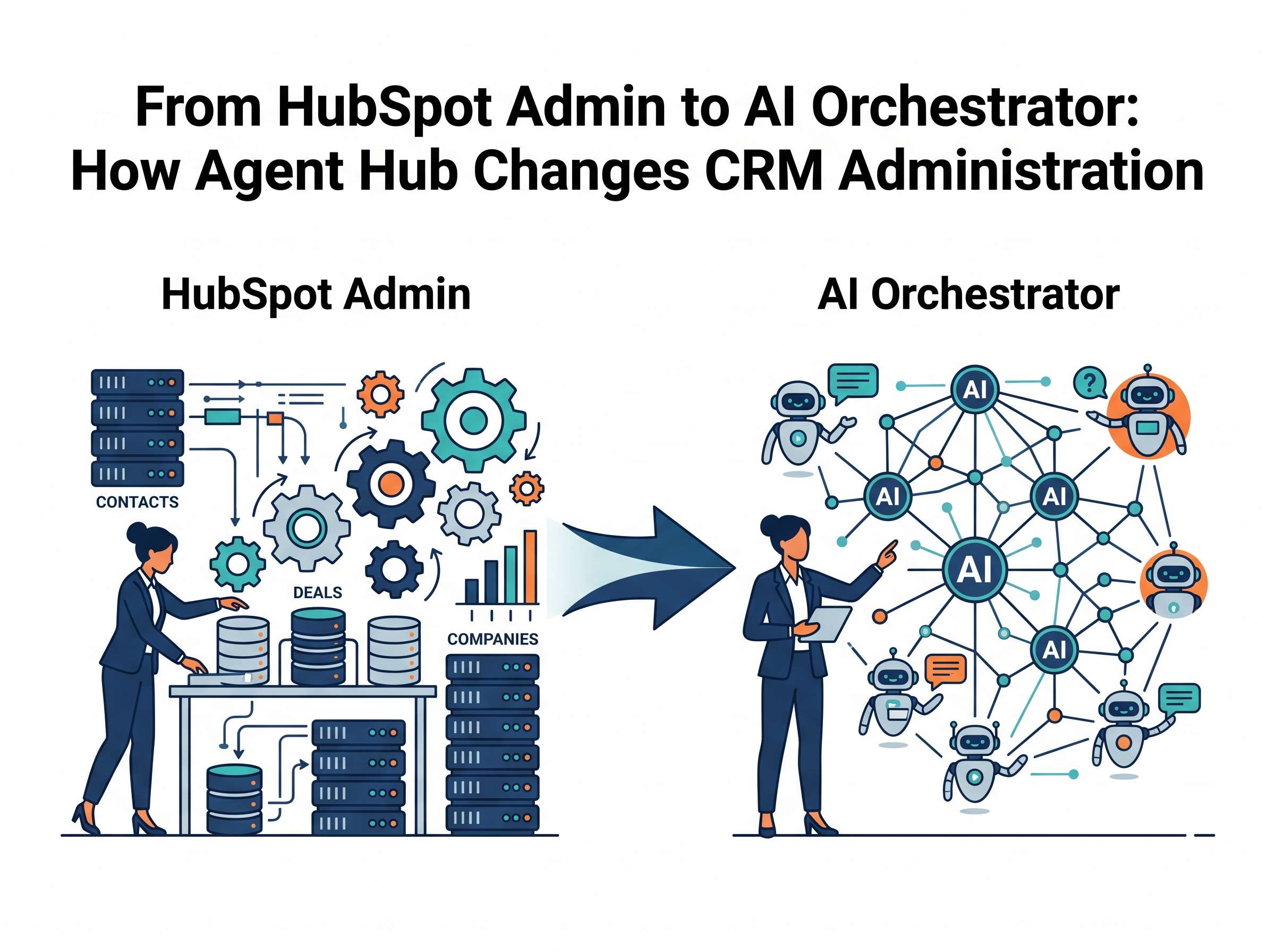
HubSpot UNBOUND 26 expands the role of the HubSpot admin from managing CRM configuration, workflows, permissions, and data into orchestrating how people and AI agents work inside HubSpot. Agent Hub centralizes agent management, Agent Builder supports custom agents and agentic workflows, Context Home provides shared business context, and Smart CRM updates give admins more control over data models, records, permissions, and system structure. For HubSpot admins, the biggest change is that AI governance, context quality, and agent oversight are becoming part of CRM administration.
The HubSpot admin role has never really been just about “admin.”
Admins are often the people quietly holding the entire system together. They manage properties. Build workflows. Clean data. Configure records. Set permissions. Troubleshoot integrations. Create reporting structures. Support users. Document processes.
And somehow answer the inevitable question: “Why did HubSpot do that?”
Now HubSpot UNBOUND 26 introduces another layer to manage. AI agents. And that changes the role in a meaningful way.
The question for HubSpot admins is no longer simply: “How should this portal be configured?”
It increasingly becomes: “How should humans, workflows, data, context, and AI agents operate together inside this portal?”
That is a much bigger job.
The HubSpot admin role is moving from configuration to orchestration
Our broader UNBOUND 26 strategy treats Agent Hub, Agent Builder, and Context Home as the foundational architecture behind HubSpot’s agentic platform.
That matters especially for admins. Because before marketing can use AI effectively, before sales can depend on AI-assisted workflows, and before service can trust Customer Agent, someone has to make sure the system underneath those experiences works.
Someone has to manage:
- Data.
- Permissions.
- Context.
- Automation.
- Agent access.
- Workflow logic.
- CRM structure.
- Governance.
- Testing.
- And ongoing maintenance.
That “someone” will often be the HubSpot admin or RevOps team. Which means admins are increasingly becoming the people responsible for orchestrating the environment AI operates within.
1. Agent Hub creates a new layer of system administration
One of the most important UNBOUND 26 releases for admins is Agent Hub.
HubSpot describes Agent Hub as a redesigned home for managing agents so teams can see what is working, understand what is possible, and act quickly.
That makes agents visible as part of the operating environment. And once agents become part of the environment, they need to be managed.
Admins will increasingly need to understand:
- Which agents exist?
- What are they responsible for?
- Who owns them?
- Which teams use them?
- What data do they rely on?
- Which workflows do they influence?
- Are they still necessary?
- Are they duplicating another process?
- Are they behaving as intended?
This looks very similar to the governance problem admins already have with workflows. Except now the system can include both deterministic automation and AI-driven behavior. That makes organization even more important.
2. Agent Builder changes who can create automation
HubSpot’s Agent Builder is another featured UNBOUND 26 product.
It allows teams to build custom agents and agentic workflows with the help of Breeze Assistant, including the ability to turn existing workflows into agentic workflows.
That lowers the barrier to creating more sophisticated automation. Which is useful.
But every admin knows what happens when creating automation becomes easy.
People create automation. Lots of it. The problem is rarely whether someone can build the workflow.
The problem comes six months later when nobody remembers:
- Why it exists.
- Who owns it.
- What it affects.
- Whether another workflow does the same thing.
- Whether it should still be running.
Agent Builder therefore creates an opportunity and a governance challenge at the same time. Admins need to think about standards before agent creation scales.
3. Agent governance should become part of portal governance
Most HubSpot admins already have some type of governance model.
Even if it is informal.
- Who can edit workflows?
- Who can change lifecycle stages?
- Who can create properties?
- Who can edit pipelines?
- Who can install integrations?
Agentic HubSpot adds another category. Who can create an AI agent?
That question quickly leads to several others.
- Who approves the agent?
- Who owns it after launch?
- What CRM information should it be able to use?
- Which actions should it be allowed to take?
- What happens when its output is wrong?
- Who monitors performance?
- How often should it be reviewed?
- How is an agent retired?
- Where should documentation live?
Those policies do not need to become bureaucratic. But they do need to exist.
Otherwise, organizations risk replacing workflow sprawl with agent sprawl.
4. Context Home makes business context an admin responsibility
Another featured release, Context Home, allows teams to view and manage what HubSpot knows about the business in one place so teams and agents can work from shared context.
That introduces a new concept into CRM administration.
Admins have traditionally managed structured CRM data.
- Properties.
- Objects.
- Associations.
- Records.
- Lifecycle stages.
- Pipelines.
Now there is another layer: business context.
If agents are going to operate based on an understanding of the business, someone needs to make sure that understanding remains accurate.
That creates questions like:
- Is the company context current?
- Does it reflect how the business actually sells?
- Are definitions aligned across teams?
- Does the system understand the right audience?
- Are there conflicting descriptions of the customer or offering?
- Who updates context when the business changes?
In other words, context becomes something that requires maintenance just like data does.
5. Your CRM data model matters even more in an agentic system
The UNBOUND 26 roadmap also includes several Smart CRM capabilities that are especially relevant to admins.
These include centralized data model management, data model health checks, cross-object filtering, record customization, real-time updates, and improvements to CRM record management.
For an admin, those are not just usability improvements.
They matter because agents and automation depend on CRM structure.
If objects are poorly defined, the system struggles. Or, associations are inconsistent, context becomes incomplete. Also, if properties are duplicated, logic becomes messy. And, of course, if lifecycle stages mean different things to different departments, automation becomes unreliable.
The more intelligence HubSpot adds to the platform, the more valuable a clean data model becomes.
Which means admins should resist the temptation to think:c“AI will make the CRM easier, so structure matters less.”
The opposite is true. Structure matters more.
6. Workflow hygiene becomes agent hygiene
Any experienced HubSpot admin has seen the workflow graveyard.
“Copy of Final Workflow.” “NEW Workflow.” “Updated Lead Routing FINAL.” “Test — DO NOT TURN ON.”
A workflow last edited three years ago that somehow still controls an important customer process.
Agentic workflows create the possibility of recreating the same problem at a new scale. Admins therefore need an inventory mindset.
For every meaningful automation or agent, teams should know:
- Purpose.
- Owner.
- Inputs.
- Actions.
- Dependencies.
- Affected objects.
- Review cadence.
- Success metric.
- Status.
- Retirement criteria.
- That sounds basic.
But basic governance becomes incredibly valuable as systems get more complex.
7. Permissions become an AI question
HubSpot’s broader UNBOUND 26 roadmap also expands administrative and developer controls.
The release materials include updates around developer permissions, runtime permission scoping, app governance, API credentials, and broader controls for how systems interact with HubSpot.
Admins need to think about permissions at two levels now.
First: Who can configure the system?
Second: What can the system itself do?
Those are different questions.
A user may have permission to build an agent.
- But what CRM data should that agent access?
- What actions can it take?
- Should it update records?
- Should it trigger workflows?
- Should it interact with external systems?
As HubSpot becomes more agentic, permissions increasingly govern not only humans but also automated actors.
That makes permission design part of AI governance.
8. Admins will need to understand how agents and workflows differ
Traditional workflows tend to operate on explicit logic.
When X happens, do Y. Agents introduce a different model.
They can operate with more context and make decisions within the boundaries of their task. That means admins increasingly need to understand when each approach makes sense. A deterministic process may still be better for something that requires absolute consistency. A more dynamic process may benefit from an agent.
The goal should not be to convert every workflow into an agentic workflow simply because the capability exists.
Admins should ask:
- Does this process require interpretation?
- Does it benefit from additional context?
- Does the output need to vary?
- Or is this still best handled with straightforward automation?
That distinction will become an important part of portal architecture.
9. Admins become the bridge between strategy and execution
Marketing may decide it wants AI-powered campaign execution. Sales may want better prospecting and deal progression. Service may want Customer Agent. Leadership may want greater automation.
But somebody has to translate those goals into the actual HubSpot environment. That often means the admin. Which makes the role increasingly cross-functional.
Admins need to understand enough about marketing to know what a campaign workflow should do.
Enough about sales to understand pipeline logic, about service to understand escalation, about data to maintain the CRM model, about AI to govern agents and enough about the business to understand context.
That is why “CRM administrator” increasingly undersells the role.
The admin is becoming an orchestrator of the customer platform.
10. AI does not reduce the need for documentation
There is a funny irony here. The more intelligent the system becomes, the more tempting it is to assume documentation matters less. But it probably matters more.
Admins should document:
- What agents exist.
- What each agent is designed to do.
- Who owns it.
- What workflows it interacts with.
- What data it relies on.
- What permissions it requires.
- How it is tested.
- How it is monitored.
- When it was last reviewed.
- What business outcome it supports.
That documentation becomes the institutional memory of the AI layer.
Without it, the portal can become difficult to govern very quickly.
What should HubSpot admins do first after UNBOUND 26?
Do not begin by creating ten agents. Start with the portal.
Audit the CRM foundation
Review:
- Core properties.
- Objects.
- Associations.
- Pipelines.
- Lifecycle stages.
- Data quality.
- Duplicate fields.
- Unused properties.
- Ownership rules.
If the CRM foundation is messy, fix that first.
Audit automation
Review:
- Active workflows.
- Old workflows.
- Duplicate logic.
- Conflicting automation.
- Unknown ownership.
- Unused processes.
Then decide where agentic workflows would actually add value.
Establish agent governance
Define:
- Who can build.
- Who can approve.
- Who owns.
- How agents are named.
- How they are documented.
- How often they are reviewed.
- How they are retired.
Review business context
Make sure HubSpot has accurate information about the business so agents and teams are working from the right foundation.
Review permissions
Determine who should have access to agent-building, workflow, CRM, and administrative capabilities.
Then scale deliberately.
A simple governance model for HubSpot admins
Admins do not need a 50-page AI policy to get started.
A practical framework could be:
- Purpose: What business problem does this agent solve?
- Owner: Who is responsible for it?
- Context: What information does it need?
- Access: What data and actions can it use?
- Human oversight: Where does someone review or intervene?
- Testing: How do we know it behaves correctly?
- Measurement: What defines success?
- Review: When will we revisit it?
- Retirement: When should it be turned off?
That is enough to move AI from experimentation into controlled operations.
The HubSpot admin role is becoming more strategic
There is a broader implication here that should not be overlooked.
Admins have historically been treated as tactical resources inside many organizations. Build this workflow. Add this field. Fix this report. Change this pipeline.
UNBOUND 26 makes that framing increasingly outdated.
When the admin controls the architecture AI depends on, the role becomes much closer to operational strategy.
Admins influence:
- How data is structured.
- How processes connect.
- How automation behaves.
- How agents act.
- How teams use the platform.
- How customer context is maintained.
- How governance works.
That is strategic infrastructure. And organizations should treat it that way.
The bigger takeaway for HubSpot admins
HubSpot UNBOUND 26 makes one thing clear: The portal is no longer only a CRM that humans operate.
It is becoming an environment where humans, automation, data, context, and AI agents operate together. Agent Hub provides a central place to manage agents. Agent Builder expands custom agent and agentic workflow creation. Context Home gives teams and agents shared business context. Smart CRM provides more control over data models, records, and CRM structure.
And our broader UNBOUND 26 content strategy places those capabilities at the foundation of the agentic platform for exactly that reason.
For HubSpot admins, the defining question after UNBOUND 26 is not: “How do I manage more AI features?”
It is: “How do I design a HubSpot environment where people and AI can work together without creating operational chaos?”
That is the new admin mandate. And it is much closer to orchestration than administration.
That is the conversation we’re here to help with. Contact us here.